Blog Money on the table
How deposits work for appointments, step by step
A $20 deposit on a Tuesday 2pm fill leaves the client's account that day, reaches your payment account a couple of business days later, and comes off their bill at the end of the appointment. It is not a hold, and the booking site does not keep it. It is a part payment you have already been paid.
Most confusion about deposits comes from not knowing that. Here is the plumbing.
A deposit is a real charge, not a hold on the card
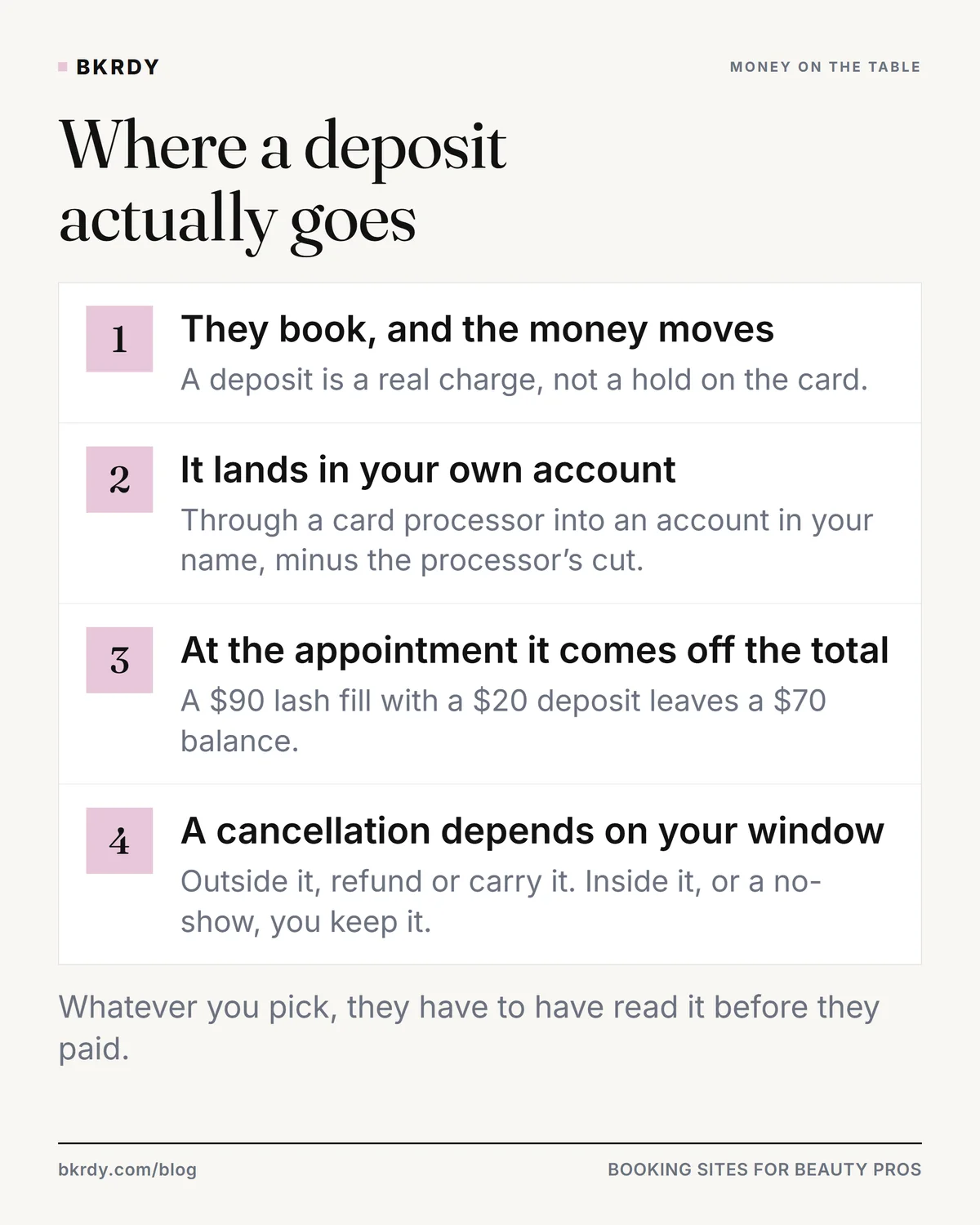
In nearly every booking setup a deposit is a real charge. The money moves the day they book, and their statement shows it like any other card purchase.
A hold, or pre-authorization, is the other thing. It reserves an amount on the card without taking it, the way a gas pump does, and it expires by itself after a few days depending on the card network. That makes it useless for an appointment three weeks out.
The money goes into your own account, minus the processor's cut
Set up properly, a deposit runs through a card processor into an account in your name. The booking software asks for the money and records it against the appointment. It does not hold it. You should see the deposit in your own processor dashboard and watch it pay out on your normal schedule. Check before you commit to a tool: some platforms take customer payments into their own merchant account and pay you on their own timetable. BKRDY takes deposits through your own Stripe account, with no markup on top of Stripe's own rate.
The processor takes its cut on the deposit as well as on the balance. Card processing is normally a percentage of the amount plus a small fixed fee per transaction, and the numbers depend on the processor, so a $20 deposit does not arrive as exactly $20. The fixed part is what makes tiny deposits expensive: the same few cents comes off $20 as off $200, and a deposit plus a balance means paying it twice. A good reason not to set a $5 one.
At the appointment, the deposit just comes off the total
Nothing clever happens on the day. The deposit is money already paid toward the service, so it reduces what is left.
| Service | Deposit paid at booking | Balance at the appointment |
|---|---|---|
| $90 lash fill | $20 | $70 |
| $90 fill plus a $15 add-on | $20 | $85 |
| $240 color correction | $50 | $190 |
Say it at booking and again in the confirmation. The most common deposit complaint is a client who thought it was a fee on top, and one line fixes that: your $20 deposit comes off your total.
Cancellations and no-shows depend on the window you set
Here the mechanics stop deciding for you. The money is already in your account, so what happens next is whatever your policy says. Three cases need an answer first.
- Cancels outside your window, more than 24 hours ahead. You have time to refill the slot, so the fair answer is a full refund, or carrying the deposit to their next booking.
- Cancels inside your window, under 24 hours. This is what the window exists for. You keep it, because the slot is too late to fill.
- No-show. You keep it, same as a late cancellation.
Whatever you pick, they have to have read it before they paid. A policy someone discovers mid-argument is not a policy. If yours is not written down, start from a cancellation policy template.
A reschedule should move the deposit once
The kindest arrangement, and the one that causes the fewest arguments, is that a deposit travels with the appointment one time. Move your Thursday to the following Tuesday and the deposit comes with you. Move it again and you pay a new one.
Once covers real life, a sick kid or a changed shift, without letting someone hold your Saturday 11am and slide it down the calendar forever. That is a choice you are making, not a rule the software hands you, so you have to state it. An unwritten reschedule rule becomes a negotiation every time.
Refunding a non-refundable deposit is still your call
You can always refund. The money goes back to the card it came from, normally within a few business days, issued from your booking software or your processor dashboard. Depending on the processor, the original fee may not come back, so a refunded deposit can leave you slightly out of pocket.
The real question is what it teaches. If your page says non-refundable and you refund every time someone pushes, clients learn the policy is a suggestion, and the ones who complain get their money back while the quiet ones do not. Keep the exception rare and say it out loud: "this is normally non-refundable, but I am making an exception this once" lands very differently from a silent refund.
Four short lines on your booking page cover the whole arrangement.
Deposit wording for your booking page
Deposits cost you a few bookings, and that is the point
Switch deposits on and some people will not book. They will fill in the form, see a card field, and close the tab. That is not the setup failing.
A client who will not put $20 behind a Saturday appointment is the client most likely not to turn up for it.
Be honest about where you are, though. If you are brand new and your book is thin, a deposit on every service can cost more than it saves. An empty Tuesday you could have filled is worse than a no-show on one you never would.
So start narrow. Deposits only on the services that hurt to lose: anything over two hours, anything where you order supplies ahead, and any prime slot you turn other people away to hold. Leave the 30 minute trim alone. Once you can see which services get ghosted, widen it, and work out how much to charge on each.
Questions
Is the deposit added to the price or taken off it?
Taken off. A $90 service with a $20 deposit leaves a $70 balance at the appointment. Put that in your confirmation message, because a first-time deposit payer often assumes it is an extra booking fee.
Can I keep a deposit when someone no-shows?
Yes, as long as your policy said so before they paid, and that is the normal arrangement. The money is already in your account, so keeping it just means not issuing a refund.
Do I pay card fees on the deposit as well as the balance?
Yes. Processors charge a percentage plus a small fixed amount per transaction, so a deposit and a balance taken separately are two transactions with two fixed fees. The rate depends on your processor, and it is why a $5 deposit rarely pays.