Blog Going solo
Booth rent vs commission: run your own break-even
The decision comes down to one number: how many clients a week you actually do. Below that number commission pays you more, above it rent does, and everything else in this argument is a tiebreaker.
Working it out takes ten minutes with your last eight weeks of bookings. Count the clients, add up what you took, divide. Then run the arithmetic below on those figures.
Commission and rent are two different bets, not two prices
Under commission you keep a share of everything you take. The salon covers the chair, the front desk, the laundry, usually the back bar products, and often the booking system and the marketing that brings people in. A slow week costs the salon too.
Under booth rent you pay a fixed amount, weekly or monthly, whether you work or not, and keep what is left. You also pick up what the salon used to absorb: your products, your card payments, your own booking page and reminders. So commission is a variable cost that moves with your week. Rent does not care what your week looked like.
Run the break-even on your own numbers
Weekly fixed cost under rent, divided by (your average ticket times the salon's percentage, minus what one client costs you in products and fees under rent) = the clients a week at which renting starts to pay.
If rent is quoted monthly, divide it by 4.3 for a weekly figure first.
Now a worked example. Round numbers, easy to follow, not a claim about any real salon. Average ticket $80. A 60/40 split in your favor, so the salon takes $32 of each ticket. The booth across town is $250 a week, and under rent you figure on $12 a client in product and card fees plus $20 a week for a booking system and supplies.
The naive answer is $250 divided by $32, which is 7.8 clients. That is the number that talks people into bad decisions, because it ignores what the salon was carrying. The real sum uses $270 of fixed cost and a net saving of $20 a client: $270 divided by $20 is 13.5. Call it 14 clients a week.
| A week with 14 clients (example) | Commission at 60/40 | Booth rent at $250 |
|---|---|---|
| Takings | $1,120 | $1,120 |
| Salon's share | $448 | $0 |
| Your products and supplies | covered | $168 |
| Rent, booking system, card fees | $0 | $270 |
| You keep | $672 | $682 |
Fourteen is a coin flip. At 20 clients a week the booth puts about $130 more in your pocket and keeps widening. At 10 you are paying for the privilege of being independent.
A quiet week under rent is a loss, not a smaller win
Run the same week with six clients. Six at $80 is $480. On commission you keep $288. On rent you keep $480 minus $72 of product minus $270 of fixed cost, which is $138. Same work, less than half the money. And in a week where you are sick or it is the second week of January, commission pays you nothing and costs you nothing, while rent is $250 owed before you unlock the door.
Rent buys you the upside and the downside at once. The upside has no ceiling. The downside is a bill arriving in a week when nobody booked.
A fair test of whether you can absorb that: could you cover eight weeks of rent out of savings?
What the arithmetic misses is who owns the client
This is the part that actually decides it. Under commission the salon usually owns the relationship: the booking system, the phone number clients have saved, the list with every email and mobile number in it, and the walk-in who asked for whoever was free.
Under rent you own your clients, and everything attached to them. The admin, the texting at 9pm, the no-shows nobody else absorbs, the slow January, chasing a deposit. Nobody is covering the front desk. You are the front desk.
Which is why a pro renting a booth needs their own booking page and client list rather than the salon's, from day one, so the people you earn stay yours if the shop sells. BKRDY's Starter plan does that for free, and the guide for solo beauty pros covers what a one-person setup actually needs.
Who should stay on commission
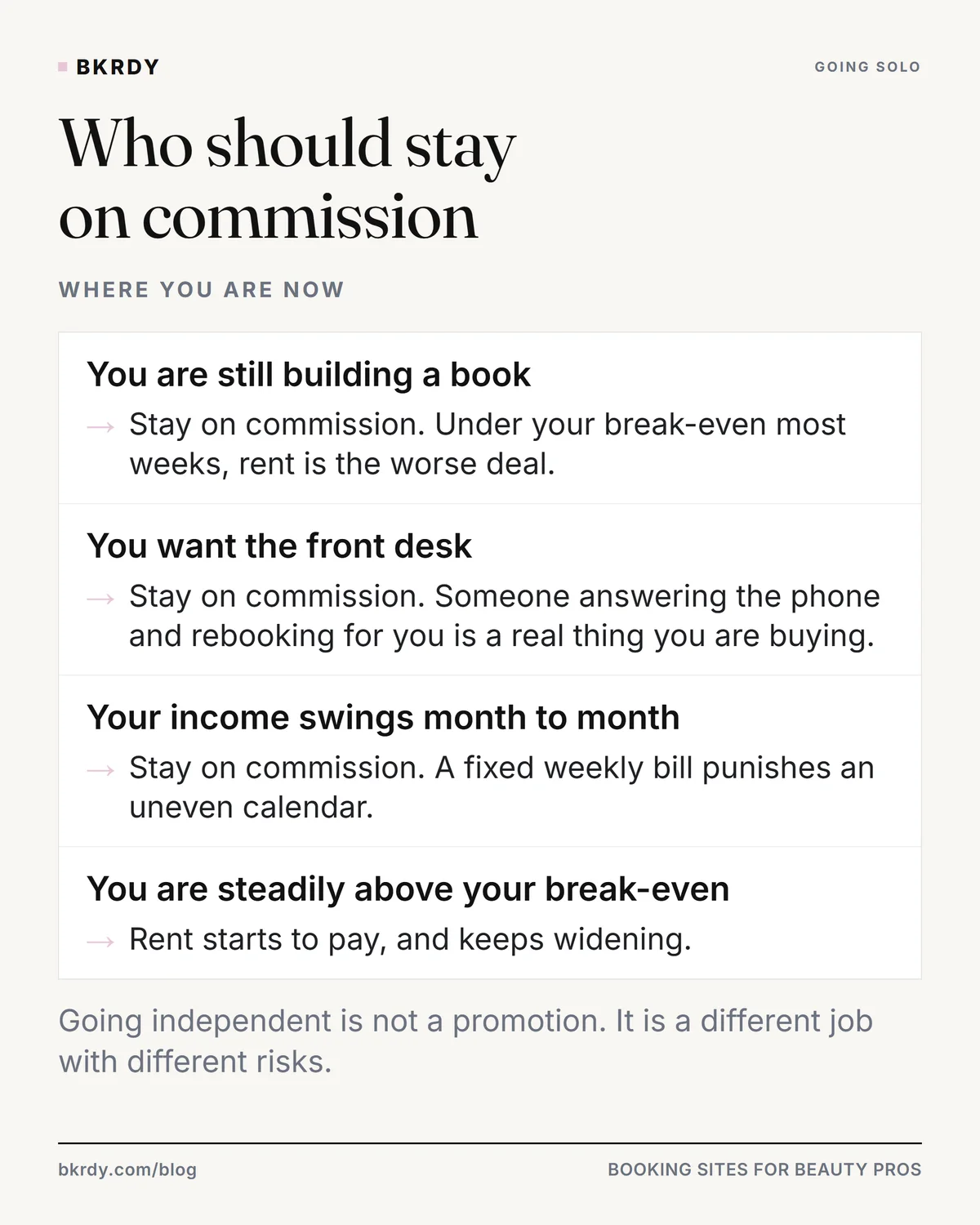
Three readers should stay put, and none of them owe anyone an apology.
- You are still building a book. Under your break-even most weeks, rent is the worse deal. Build a steady week first and let the salon carry the risk while you do.
- You want the front desk. Some people are brilliant with clients and hate running a business. Someone answering the phone and rebooking for you is a real thing you are buying.
- Your income swings month to month. Seasonal work, school schedules, health, a second job. A fixed weekly bill punishes an uneven calendar. Commission flexes on its own.
Going independent is not a promotion. It is a different job with different risks.
Get these in writing before you take a booth
Verbal agreements between people who like each other hold up fine until the rent goes up or the shop sells. Ask for this on paper before you give notice anywhere. Much of it is negotiable if you raise it early.
Message to the salon owner before you sign
One thing an article cannot do: have a lawyer read the agreement before you sign, and talk to an accountant about your own situation. Do both.