Blog Switching
Is Booksy legit, safe, and worth it? An honest answer
Yes, yes, and it depends on your stage. Those are the three answers, in the order people search for them. Booksy is a real company, your money and your client data are handled the normal way, and whether the fee is worth paying comes down to one number you can count yourself in ten minutes.
The three questions get searched separately, usually answered by somebody with a reason to scare you. They are really one decision.
Legit is the easy one
Booksy has been running for years, with apps in both stores and millions of appointments booked through it. It is not a scam and it is not going to vanish with your calendar next month.
If something in the search results made you nervous, it was almost certainly a frustrated review: the admin side feeling clunky, or a billing line somebody did not expect. Both are fair, and neither is about whether the company is real. Legit does not mean right for you, and that is the part worth your attention.
Safe, on everything people actually mean by safe
Card payments run on the same standard processing rails as any other booking platform. Payouts arrive. Client details and appointment history are handled the way you would expect from a company that size.
There is one genuinely useful caution here, and it is not about safety at all. Keep your own copy of your client list: names, emails, phone numbers, exported to a spreadsheet you control. That is not a warning about Booksy. It is sensible on any platform you do not own, and it applies as much to BKRDY as to them. A locked account, or a decision to move in two years, gets easier when the list is already in your hand. Set a quarterly reminder in your phone. It takes four minutes.
Worth it is a stage question, not a good-or-bad question
Booksy is a marketplace first. Somebody opens the app, searches for a balayage or a beard trim near them, scrolls, and books whoever looks good. The calendar and the reminders are real software, but what you are subscribing to is a queue of strangers.
When nobody knows your name, that queue is worth a lot. A new lash artist with forty followers cannot generate strangers on her own, and the marketplace genuinely can. Then your business changes and the product does not.
The day most of your bookings come from people who already know exactly who you are, you are paying a marketplace to introduce you to your own regulars.
Nothing about Booksy got worse at that point. You stopped needing the thing it sells, and the fee keeps coming out either way.
The cost, in shape rather than in numbers
A monthly subscription, more for each extra staff member, and card processing on top. The per-person layer surprises people: a solo pro and a three chair shop are nowhere near the same bill, and the gap widens with every chair. There is also an optional paid promotion that pushes your profile higher in marketplace search. Prices change, so do not trust a figure from any blog post, including this one. Check Booksy's own page, and the Booksy pricing breakdown for how the layers stack.
The promotion is not a trick. It is an auction for position, and it works. The catch is structural: the more competitors pay to rank, the more it costs to stay where you already were, and that cost grows as a market gets busier rather than shrinking. In a quiet town it can be cheap for years. In a dense city it is a bill that goes one direction.
Count your last thirty bookings this week
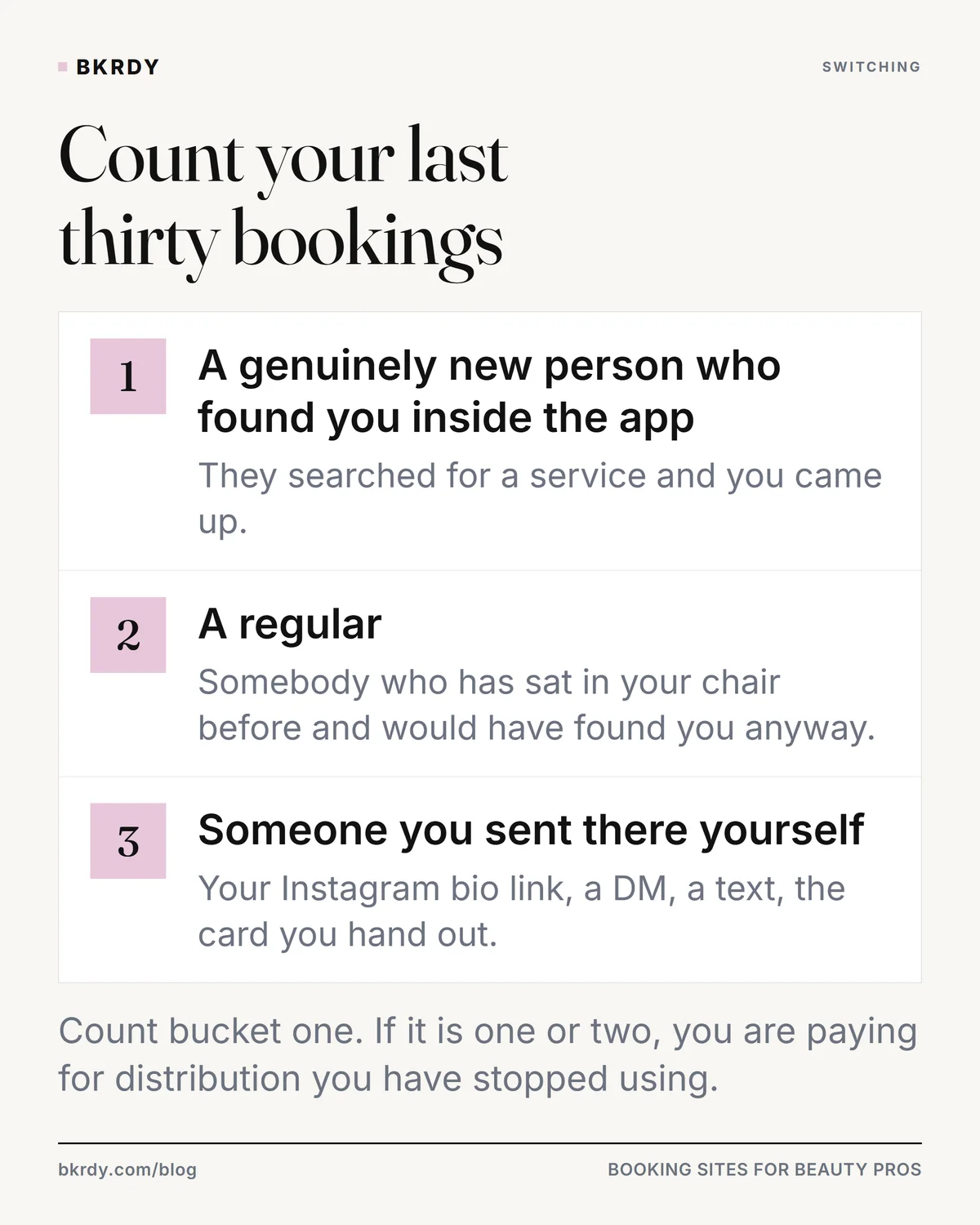
Open your calendar and scroll back through the last thirty appointments. Put each one in exactly one of three buckets:
- A genuinely new person who found you inside the app. They searched for a service and you came up.
- A regular. Somebody who has sat in your chair before and would have found you anyway.
- Someone you sent there yourself. Your Instagram bio link, a DM, a text, the card you hand out.
Count bucket one. That ratio is your answer. If ten or more of the last thirty were strangers out of the app, the marketplace is doing real work. If it is one or two, you are paying for distribution you have stopped using, and bucket three is the tell: you are routing your own clients through a paid introduction to reach you. Run the count in a busy month and again in a slow one, because February and August can look like two different businesses.
If you leave, the finding becomes your job
A marketplace does one thing you then have to do yourself: it finds people who have never heard of you. Leave it and that work lands on your Instagram, your Google Business Profile, and how often you ask a happy client to tell a friend.
For some people that trade is simply wrong. If you hate posting, if you have no time for it, if you are in a city where opening the app is how people shop for a fade, then paying for strangers is the correct decision. Nothing stops you running both for a season either: regulars book on your own site, new clients still come through the app, and you watch which column grows. The honest comparison of salon booking software covers who each platform suits.
If you do move your regulars, one text does it.
A text to send regulars when your booking moves
Be clear about what the alternative is, though. Something like BKRDY is not a marketplace: nobody else is advertised next to you, nobody outbids you for your own name, and the client list is yours. That is a different product, not a better version of the same one. Which one you need is the stage question again, and only your last thirty bookings can answer it.
Questions
Is Booksy legit?
Yes. It is a large, established booking platform with years of operation, millions of bookings, and apps in both major stores. The negative reviews are usually about the admin experience or an unexpected charge, not about whether the company is real.
Is Booksy safe to use?
Yes, on the things people mean by safe. Payments run through standard processing, payouts arrive, and client data is handled normally. The one habit worth keeping is your own exported copy of your client list, sensible on any platform you do not control.
Is Booksy worth the monthly fee?
It depends where your business is. It is worth it while the marketplace brings you clients you could not reach alone, and hard to justify once most bookings are regulars or people you sent there yourself.
How much does Booksy cost?
A monthly subscription, more for each additional staff member, and card processing on top, plus an optional paid promotion. Prices change, so check Booksy's own page rather than trusting a figure in an article.