Blog
Discover what appointment frequency means for clients and how it affects your beauty results. Learn to optimize your scheduling today!
Appointment frequency is defined as the regular interval at which a client books and attends sessions with their beauty professional. Understanding what does appointment frequency mean for clients goes beyond knowing how often to show up. It shapes the quality of your results, the strength of your relationship with your studio, and how smoothly your scheduling experience runs. Whether you visit a lash artist every two weeks or a nail technician monthly, that rhythm is not random. It is a deliberate plan built around your service needs and goals.
Appointment frequency is the single biggest factor in whether beauty treatments deliver lasting results. Consistent frequency in services leads to better client satisfaction and stronger outcomes because each session builds on the last. Think of lash fills: skipping a scheduled appointment does not just delay your next visit. It breaks the cumulative effect that keeps your lashes looking full and even.
The same logic applies across beauty services. Regular nail appointments prevent breakage and maintain the integrity of the product applied. Consistent skincare facials allow an esthetician to track your skin’s response and adjust treatments over time. Spaced appointments allow clients to reinforce results between sessions and give professionals the feedback they need to refine their approach.
Frequency also builds trust. When your studio sees you on a predictable schedule, they learn your preferences, your sensitivities, and your goals. That knowledge accumulates into a service experience that feels personal rather than generic. Client preference tracking is far more effective when appointments happen at consistent intervals.
Pro Tip: If you are unsure whether your current schedule is working, ask your beauty professional at your next visit. A simple conversation about your goals can lead to a frequency plan that gets you better results faster.
The industry uses three primary scheduling intervals, and each one signals a different phase of your care plan.
| Frequency | Typical services | What it means for you |
|---|---|---|
| Weekly | Active treatment phases, corrective skincare | Rapid progress; requires more time commitment |
| Biweekly (every 2 weeks) | Lash fills, gel nails, brow shaping | Steady maintenance with visible consistency |
| Monthly | Facials, hair color, waxing | Standard upkeep for stable, long-term results |
| Every 6-8 weeks | Haircuts, deep conditioning treatments | Seasonal or low-maintenance care cycles |
Initial service phases often require shorter appointment intervals to build rhythm and momentum for the best outcomes. A new lash client, for example, may start with a full set and return every two weeks until the technician understands how their natural lashes behave. After that, the schedule may shift.
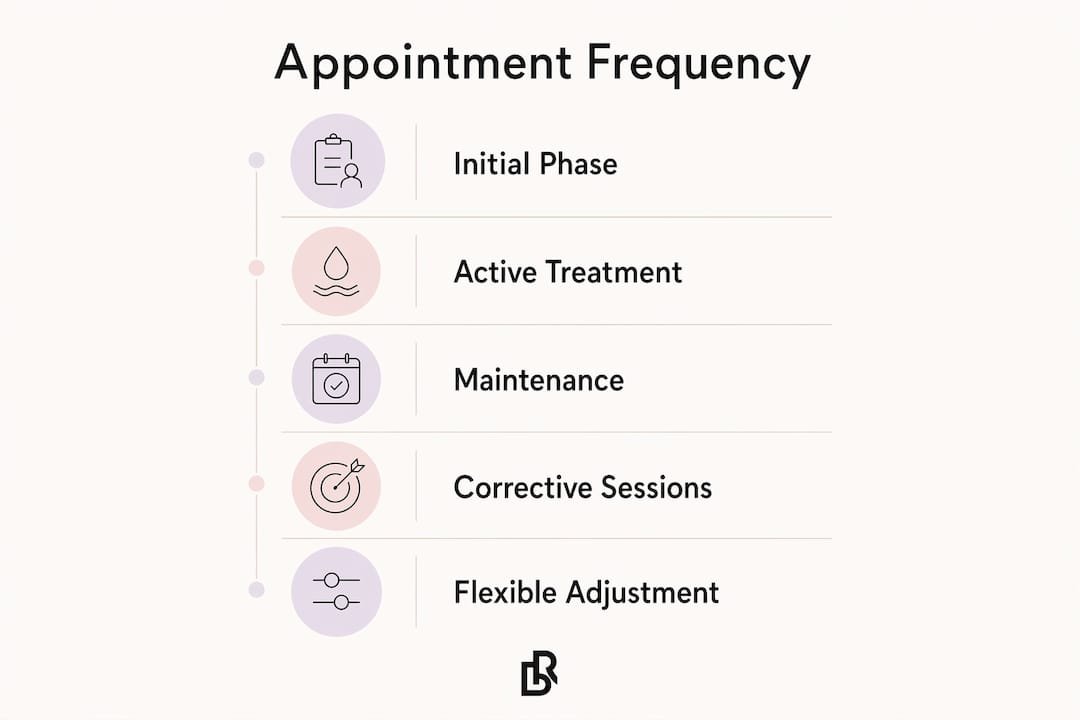
Frequency is not fixed forever. Appointment frequency evolves as client goals and needs change, allowing flexibility to lengthen intervals during maintenance phases. A client who started with weekly corrective facials may move to monthly visits once their skin stabilizes. That shift is a sign of progress, not neglect.
Your lifestyle matters too. A client who travels frequently or has a demanding schedule may need a biweekly plan rather than weekly, even if weekly would produce faster results. The best frequency is the one you can actually keep.
Pro Tip: Ask your beauty professional what phase of care you are in. Knowing whether you are in an active treatment phase or a maintenance phase helps you understand why your current frequency was recommended.
Studios recommend specific frequencies because the service itself has a biological or product-based timeline. Lash extensions shed with your natural lash cycle, which runs roughly every two to three weeks. Gel polish bonds to the nail plate and grows out at a predictable rate. These timelines are not arbitrary. They are built into the service design.
Beyond the service itself, recurring appointment scheduling creates a smoother booking experience by eliminating repeated rebooking messages and calendar management hassles. When your studio recommends a fixed frequency, they are also reducing the friction of scheduling for both of you. You stop hunting for open slots. They stop chasing clients who forgot to rebook.
Fixed recurring series enable clients to lock in preferred appointment times for weeks or months, enhancing convenience and relationship stability. If you always want a Saturday morning slot, a recurring booking secures it before anyone else can claim it. That kind of consistency is genuinely hard to replicate with ad hoc scheduling.
Frequency recommendations also protect the studio’s ability to deliver quality work. A client who shows up six weeks late for a lash fill may need a full set instead, which takes longer and costs more. Staying on schedule keeps both the result and the cost predictable.
Pro Tip: When your studio offers to set up a recurring appointment, say yes. You can always reschedule individual sessions if something comes up, but you keep your spot secured in the meantime.
Appointment frequency is the foundation of a productive client-studio relationship. Client understanding of appointment frequency fosters collaboration and accountability, improving attendance and satisfaction. When you know why your studio recommends a certain schedule, you are more likely to follow it and more likely to speak up when life gets in the way.
Transparency in scheduling communication works both ways. Studios that explain their frequency recommendations build trust faster than those that simply hand over a booking link. Clients who understand the reasoning behind their schedule feel like partners in their own care rather than passive recipients of a service.
About 39% of missed appointments result from forgetfulness, which increases when sessions lack regularity. A predictable schedule, paired with automated reminders, cuts that number significantly. Regularity itself becomes a reminder. When you know you always go in on the second Tuesday of the month, you stop forgetting.
| Client behavior | Consistent frequency | Irregular frequency |
|---|---|---|
| Result quality | Builds progressively | Resets with each gap |
| Relationship with studio | Personalized and informed | Transactional and surface-level |
| Scheduling experience | Predictable and low-effort | Repetitive rebooking hassle |
| Cost over time | Stable and predictable | Higher due to corrective sessions |
| Accountability | High; schedule creates habit | Low; easy to skip or delay |
The professional rapport built through consistent appointments is genuinely hard to replicate. Your beauty professional remembers what you like, anticipates what you need, and delivers a better result because they know your history. That knowledge only accumulates when you show up on schedule.
Appointment frequency is the most controllable factor in the quality and consistency of your beauty service results.
| Point | Details |
|---|---|
| Frequency drives results | Consistent intervals build cumulative effects that irregular visits cannot replicate. |
| Schedules are service-specific | Each beauty service has a natural timeline that determines the ideal booking interval. |
| Recurring bookings reduce hassle | Booking once for a recurring slot removes repeated scheduling effort for both client and studio. |
| Missed appointments cost more | Gaps in frequency often require corrective sessions that take longer and cost more. |
| Frequency builds the relationship | Regular visits allow studios to personalize service and track your progress over time. |
Most clients think of appointment frequency as a logistical detail. Book when you can, show up when it works. After watching how beauty studios operate, I am convinced that mindset costs clients real money and real results.
The clients who get the best outcomes are not the ones who spend the most per visit. They are the ones who show up on schedule, every time. Their beauty professional knows them. The service is dialed in. There is no guesswork about what was done last time or how the product behaved.
The biggest misconception I see is that skipping a session is neutral. It is not. Skipping breaks the cumulative effect of the service and often means the next appointment has to do double the work. That is more time in the chair and sometimes a higher bill.
My honest advice: treat your appointment frequency as a commitment to yourself, not just to your studio. When you understand why the schedule exists, it stops feeling like an obligation and starts feeling like a plan that works in your favor.
, Luis
Keeping up with a regular beauty schedule is much simpler when the booking experience does not get in the way. Bkrdy builds spa booking websites designed specifically for independent beauty studios, with recurring appointment setup built directly into the platform.
Clients can lock in their preferred time slots without back-and-forth messages, and studios can send automatic reminders that reduce no-shows. Bkrdy also stores your service history so your beauty professional always has context before you walk in. For esthetician clients especially, that history makes every visit more effective. If your studio uses Bkrdy, your frequency plan is already working for you behind the scenes.
Appointment frequency is the regular interval at which a client books and attends sessions with their beauty professional. It directly affects the quality of results, the cost of services, and the strength of the client-studio relationship.
The right frequency depends on the service. Lash fills typically require every 2-3 weeks, nail appointments every 2-4 weeks, and facials monthly. Your studio will recommend a schedule based on your specific service and goals.
Recurring scheduling removes repeated rebooking conversations and secures your preferred time slot before it fills up. It also helps studios prepare for your visit and deliver more consistent results.
Irregular frequency breaks the cumulative effect of beauty treatments and often requires corrective sessions that take longer and cost more. Forgetfulness accounts for about 39% of missed appointments, so a predictable schedule paired with reminders is the most effective solution.
Yes. Frequency typically starts higher during active treatment phases and decreases once you reach a maintenance stage. Your beauty professional will adjust the recommendation as your results stabilize and your goals shift.
BKRDY
Pick a template, take deposits, and let clients book on your own branded site. 30-day free trial.
Start your 30-day trial