Blog
Discover the crucial role of client-facing booking pages in beauty businesses. Optimize yours to convert visitors into confirmed appointments!
A client-facing booking page is the digital interface where clients schedule their appointments directly, making it the frontline conversion tool for every beauty business. Most beauty professionals treat their booking page as an afterthought. That is a costly mistake. The role of client-facing booking pages goes far beyond displaying a calendar. These pages function as sales pages with scheduling built in, designed to convert high-intent visitors into confirmed appointments without friction. When your booking page works well, your calendar fills. When it does not, clients leave and book somewhere else.
A booking page is not just a scheduling tool. It is the moment a potential client decides whether to commit or walk away. Booking pages remove friction to convert high-intent visitors, which means every design choice, every form field, and every loading second directly affects your revenue.
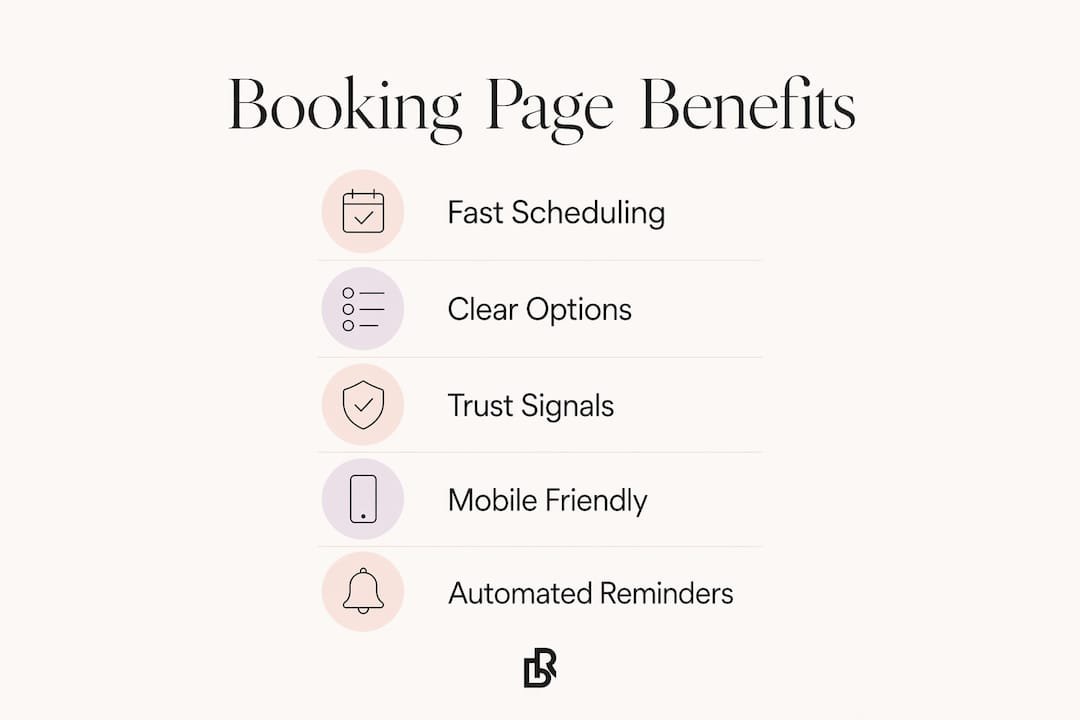
The industry standard for effective booking pages rests on three pillars: speed, clarity, and trust signals. Speed means the page loads fast and the path to confirmation is short. Clarity means clients immediately understand what service they are booking, how long it takes, and what it costs. Trust signals include recognizable branding, clear cancellation policies, and secure payment options.
Beauty appointments are personal and often high-value. A client booking a lash set or a balayage is not making an impulse purchase. They are choosing someone to trust with their appearance. Your booking page either reinforces that trust or erodes it. A page that looks generic, loads slowly, or asks confusing questions tells the client your studio does not pay attention to details.
The new client booking flow for beauty professionals is especially critical because first-time clients have no prior relationship with you. The booking page is their first real interaction with your brand, and it sets the tone for everything that follows.
Booking pages improve client engagement by filtering for quality appointments before the client ever walks through your door. A well-designed page asks the right questions upfront, such as service type, hair length, or skin concerns, without overwhelming the client with a form that looks like a therapist’s intake sheet.
Here is what a high-performing booking page does for client engagement:
Pro Tip: Add a short “what to expect” note directly on your booking confirmation page. Clients who know how to prepare arrive on time and ready, which keeps your schedule tight.
Client engagement through bookings is not just about filling slots. It is about starting the client relationship on a professional, organized note. When a client books through a page that reflects your brand and communicates clearly, they arrive with higher confidence in your work before you have even picked up a brush.
Mobile is where your clients are booking. Over 60% of appointment bookings start on mobile devices, and abandonment rises sharply when booking flows take longer than three seconds or require more than three steps. That single fact should reshape how you think about your booking page design.
A mobile-friendly booking page is not simply a desktop page that shrinks to fit a phone screen. It is a purpose-built experience that accounts for thumb navigation, small text input, and interrupted browsing sessions. Here is what mobile optimization looks like in practice:
Stat to know: Mobile bookings account for 60-75% of all online bookings as of 2026. If your booking page is not built for mobile first, you are losing the majority of your potential appointments.
Pro Tip: Test your booking page on three different phone models every quarter. What looks fine on your own phone may break on an older Android device your clients are using.
The role of mobile-friendly booking pages is not a trend. It is the baseline expectation your clients bring to every interaction with your business.
A booking page connected to the right tools does far more than schedule appointments. It builds client profiles, reduces administrative work, and keeps your business running between sessions.
CRM integration and client profiling are the foundation of a well-connected booking system. CRM-integrated booking pages enable progressive client profiling, collecting minimal data at booking and richer preferences afterward. For a lash artist, this means knowing a returning client’s preferred curl type before they arrive. For a nail tech, it means remembering a client’s sensitivity to certain products. That level of personalization is what turns one-time clients into regulars.
Automated reminders are the single highest-return feature you can add to your booking system. Clients who receive reminders are significantly less likely to miss appointments, which directly protects your revenue. Bkrdy’s automated reminder system sends timed notifications so you never have to chase clients manually.
Self-serve rescheduling reduces the back-and-forth that eats up your time between appointments. When clients can reschedule on their own through the booking portal, they are more likely to keep the appointment rather than cancel outright. It also removes the awkward phone call that neither party enjoys.
Unified branded portals tie everything together. When your booking page, confirmation emails, and reminder messages all carry the same visual identity and tone, clients experience your brand as consistent and professional at every touchpoint.
| Feature | Client benefit | Business benefit |
|---|---|---|
| Automated reminders | Never misses an appointment | Fewer no-shows, stable revenue |
| Self-serve rescheduling | Flexible, no phone calls needed | Less admin time, fewer cancellations |
| CRM client profiles | Personalized service every visit | Higher retention, better upsell opportunities |
| Real-time availability | Books instantly, no waiting | Eliminates double-booking |
A booking page that converts is one that gets out of its own way. The goal is a clear path from “I want to book” to “appointment confirmed” with as few obstacles as possible.
The most effective design choices for beauty booking pages follow a consistent pattern:
For beauty professionals running multiple service types, segmenting booking pages by traffic source adds another layer of relevance. A client clicking from your lash extension Instagram post should land on a page focused entirely on lash services, not a general menu. Relevance at the point of arrival increases completion rates.
The online booking setup guide from Bkrdy walks through these design decisions in detail, with examples built specifically for beauty studios.
A well-designed client-facing booking page is the single most direct tool a beauty professional has to convert interest into confirmed, quality appointments.
| Point | Details |
|---|---|
| Booking pages are sales tools | They exist to remove friction and convert high-intent visitors, not to re-explain your services. |
| Mobile-first design is non-negotiable | Over 60% of bookings start on mobile; slow or complex pages lose the majority of potential clients. |
| Brand consistency builds trust | Matching your booking page to your website and social presence reduces abandonment and builds client confidence. |
| Integrations multiply effectiveness | Automated reminders, CRM profiles, and self-serve rescheduling turn a booking page into a full client management system. |
| Simplicity drives conversions | Fewer form fields, plain language, and a visible call to action consistently outperform complex, feature-heavy pages. |
Most beauty professionals I have spoken with underestimate what their booking page is actually doing. They set it up once, share the link, and assume it is working. The honest truth is that a booking page is a living part of your business, and it needs the same attention you give your technique.
The biggest shift in thinking I would encourage is this: stop treating your booking page as a scheduling utility and start treating it as a conversion moment. The client who lands on your page has already decided they want the service. Your only job at that point is to not talk them out of it. A confusing form, a slow load, or a page that looks nothing like your brand does exactly that.
The second thing I have seen make a real difference is testing. Not a full redesign every six months, but small experiments. Change the button color. Rewrite the service description. Remove one form field. These micro-adjustments, measured over a few weeks, reveal what your specific clients respond to. No article, including this one, can tell you exactly what your clients want. Only your own data can do that.
Finally, I would push every beauty professional to prioritize client feedback on the booking experience. Ask new clients how they found the booking process. Ask returning clients if anything felt confusing. That direct input is more valuable than any UX best practice list.
, Luis
Beauty professionals who want a booking page that reflects their brand without spending weeks on setup have a direct path forward with Bkrdy.
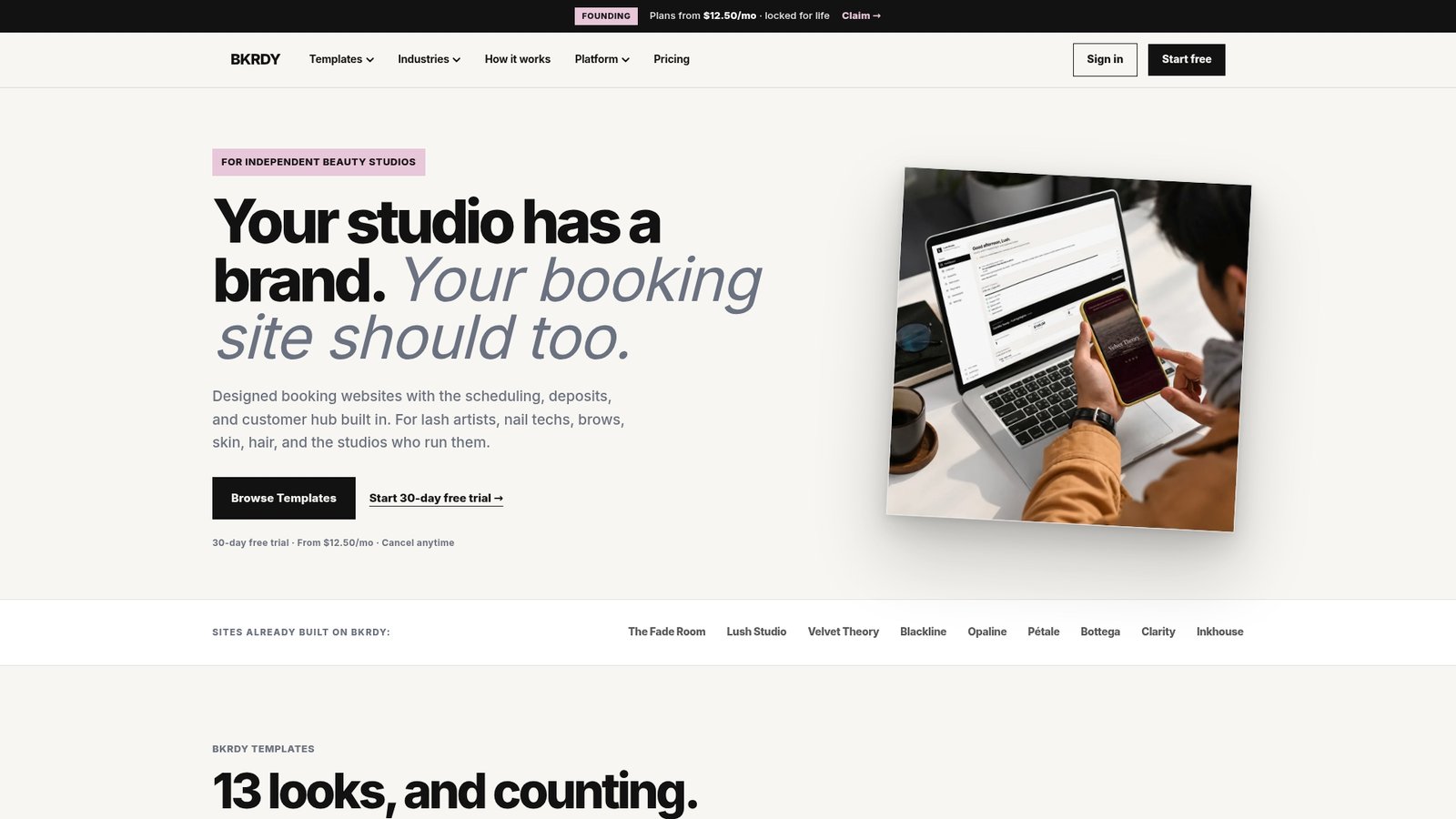
Bkrdy builds spa booking websites and salon booking sites designed specifically for independent beauty studios, including lash artists, nail technicians, estheticians, and hairstylists. Every site includes built-in scheduling, deposit handling through Stripe, automated client reminders, and self-serve rescheduling. The design matches your brand from day one, and setup does not require a developer or a design background. If you want a booking page that converts and represents your studio professionally, Bkrdy is built for exactly that.
A client-facing booking page is the web page where clients directly schedule their appointments with a beauty professional. It functions as a sales page with a calendar, designed to convert interest into confirmed bookings with minimal friction.
Over 60% of appointment bookings start on mobile devices, and abandonment rises sharply when booking flows take longer than three seconds or require more than three steps. A mobile-optimized page loads fast, uses simple forms, and offers one-tap payment options.
Automated reminders notify clients of upcoming appointments through text or email, significantly reducing the likelihood they forget or skip. Beauty professionals using automated reminders report more predictable revenue and fewer last-minute cancellations.
A strong beauty booking page includes real-time availability, service descriptions with pricing and duration, automated confirmation and reminders, self-serve rescheduling, and brand-matched design. CRM integration for client profiles adds long-term retention value.
Matching your booking page colors, logo, and tone with your main website reduces client hesitation and abandonment. Clients who recognize your brand throughout the booking process complete their appointment with higher confidence.
BKRDY
Pick a template, take deposits, and let clients book on your own branded site. 30-day free trial.
Start your 30-day trial