Blog
Discover the role of rebooking prompts in client retention. Boost your appointment rates and revenue with effective strategies for 2026.
Rebooking prompts are defined as direct, in-person or automated requests that ask a client to schedule their next appointment before or immediately after leaving. The role of rebooking prompts in client retention is straightforward: they convert a single visit into a recurring relationship. Appointment-based businesses targeting a 40-65% rebooking rate achieve strong client retention, with elite studios exceeding 65% by standardizing the ask at checkout. A 10% increase in rebooking rate can generate a 30-50% revenue lift. Retaining a client also costs 5-7 times less than acquiring a new one, which makes the rebooking conversation one of the highest-return habits in any beauty business.
The numbers here are hard to ignore. 68% of salon clients who do not pre-book before leaving never return, often because they forget or find a more convenient option elsewhere. That single statistic reframes the rebooking ask from a nice-to-have into a business-critical step.
The psychology behind this is simple. When a client commits to a future date before walking out the door, they have made a decision. That decision reduces the mental friction of rebooking later. Without it, the client leaves with good intentions but no anchor. Life gets busy, the weeks pass, and the next thing you know they are sitting in someone else’s chair.
Pre-booking also delivers practical benefits beyond loyalty:
The behavioral case is equally strong. Most clients do not rebook because they are unhappy. They fail to rebook because no one asked. The prompt itself is the intervention.
The most common mistake in rebooking is asking the wrong question. “Do you want to book your next appointment?” invites a yes or a no, and a distracted client almost always says no. Vague closing questions produce non-committal answers. The fix is to offer two concrete options instead.
Assumptive language in rebooking scripts shifts the conversation from “if” to “when.” Here is how that plays out in practice:
Pro Tip: Embed the rebooking prompt into your POS or checkout workflow so it fires every time, not just when you remember. Consistency is what moves the needle on your monthly rebooking rate.
Handling objections is also a skill worth training. When a client says “I’ll call you,” respond with: “Totally fine. Let me put a tentative hold on your usual time and you can confirm by Friday.” That keeps the slot warm and gives the client an easy path back.
Team training matters here. Training stylists to integrate rebooking improves client relationships and retention across the board. Role-play the scripts in team meetings. Make the rebooking ask feel as natural as handing back a credit card.
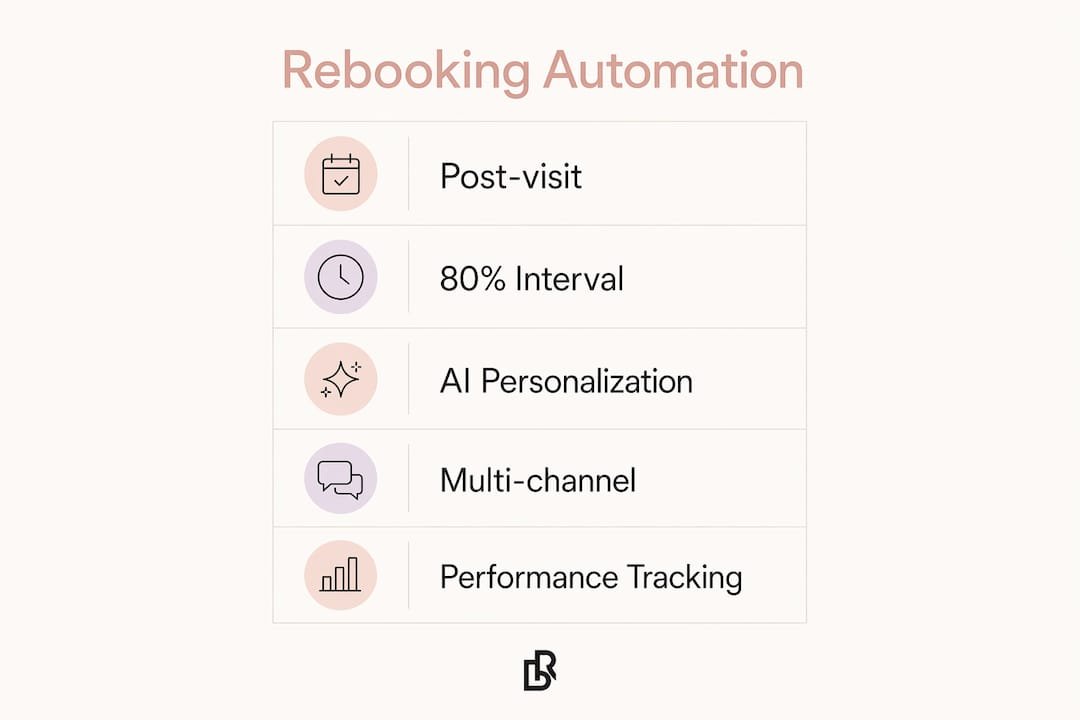
Manual rebooking prompts work well at checkout, but they break down for clients who leave without booking. Automation fills that gap. Automated rebooking reminders sent at 80% of the average service interval hit the optimal timing for securing return visits. For a client on a six-week color cycle, that means a reminder fires around week five, when the need is real but the calendar is not yet full.

Timing matters more than most beauty professionals realize. Send the reminder too early and the client ignores it. Send it too late and they have already booked elsewhere or decided to wait. The 80% interval rule is the sweet spot.
AI-driven CRMs can personalize reminders by client behavior patterns. A client who always books on Saturday mornings gets a Saturday-morning prompt. A client who consistently extends to eight weeks gets a reminder at week six, not week five. That level of personalization makes the message feel like a service, not a marketing blast.
Multi-channel delivery also improves results. SMS tends to get opened faster than email, but email allows for richer content like a booking link, a photo of the client’s last look, and a review request. Using both channels for different moments in the follow-up sequence covers more ground.
| Automation type | Best timing | Primary channel | Main benefit |
|---|---|---|---|
| Post-visit confirmation | Immediately after appointment | SMS or email | Reduces no-shows, builds trust |
| Rebooking reminder | ~80% of service interval | SMS | Catches client at peak need |
| Follow-up with review ask | 24-48 hours post-visit | Builds loyalty and new referrals | |
| Lapsed client re-engagement | 2x average service interval | Recovers clients before they are lost |
Pro Tip: Track your rebooking reminders by channel. If SMS outperforms email by a wide margin for your client base, shift more of your follow-up budget there. The data will tell you what your clients actually respond to.
Bkrdy builds automated reminders directly into its booking platform for beauty professionals, so the follow-up sequence runs without manual effort. For solo pros and independent studios, that kind of built-in automation removes the operational burden of chasing clients individually.
Rebooking rate is the foundational metric for client retention. The formula is simple: divide the number of clients who rebooked by the total number of appointments in a given period, then multiply by 100. A rate below 40% signals a serious gap. A rate above 65% puts you in the top tier of the industry.
Measuring rebooking rates by stylist and service creates clear insights for coaching and accountability. If one stylist runs at 70% and another at 35%, the gap is not random. It reflects a difference in how the rebooking conversation is being handled. That data gives you a specific, fair basis for a coaching conversation.
Key metrics worth tracking alongside rebooking rate include:
Rebooking should be treated as an operating principle, measured and managed per stylist to identify coaching needs and improve overall retention. Reviewing these numbers monthly, not quarterly, keeps the team accountable and lets you catch problems before they compound.
Consistent rebooking prompts, backed by assumptive scripts, automated follow-ups, and stylist-level tracking, are the most direct path to sustainable client retention in any beauty business.
| Point | Details |
|---|---|
| Rebooking rate benchmark | Target 40-65%; elite studios exceed 65% by asking at every checkout. |
| The cost of not asking | 68% of clients who leave without rebooking never return, making the prompt non-negotiable. |
| Script language matters | Assumptive phrasing (“when” not “if”) and two concrete options outperform open-ended questions. |
| Automate the follow-up | Reminders sent at 80% of the service interval hit the optimal window for securing return visits. |
| Measure by stylist | Tracking rebooking rates per team member reveals coaching gaps and drives accountability. |
The most common objection I hear from stylists is that asking for a rebooking feels pushy. I understand the instinct. Nobody wants to feel like they are running a sales floor. But that framing is the problem. Clients expect and appreciate being asked to schedule their next visit. Skipping the ask does not protect the relationship. It actually signals that you are indifferent to whether they come back.
What I have seen work, consistently, is treating rebooking as an operational standard rather than a personal choice. When every stylist on the team asks every client at every checkout, the behavior stops feeling awkward. It becomes part of the rhythm of the appointment, as natural as confirming the service price.
The studios that struggle most are the ones where rebooking is left to individual stylist preference. Some ask, some do not, and the result is a wildly inconsistent retention rate that no one can explain. The fix is not motivation. It is structure. Build the prompt into your checkout process, train the language, and measure the results by person. The improvement is almost always immediate.
One more thing: personalized follow-ups matter more than most people expect. A message that references the client’s actual service, “Your balayage should be looking great right now, time to book your toner refresh,” lands completely differently than a generic reminder. That specificity is what turns a transactional prompt into a relationship touchpoint.
, Luis
Beauty professionals who want to put these strategies on autopilot have a real advantage when their booking platform is built for it. Bkrdy is designed specifically for independent studios, lash artists, nail technicians, hairstylists, and estheticians who need more than a generic booking link.
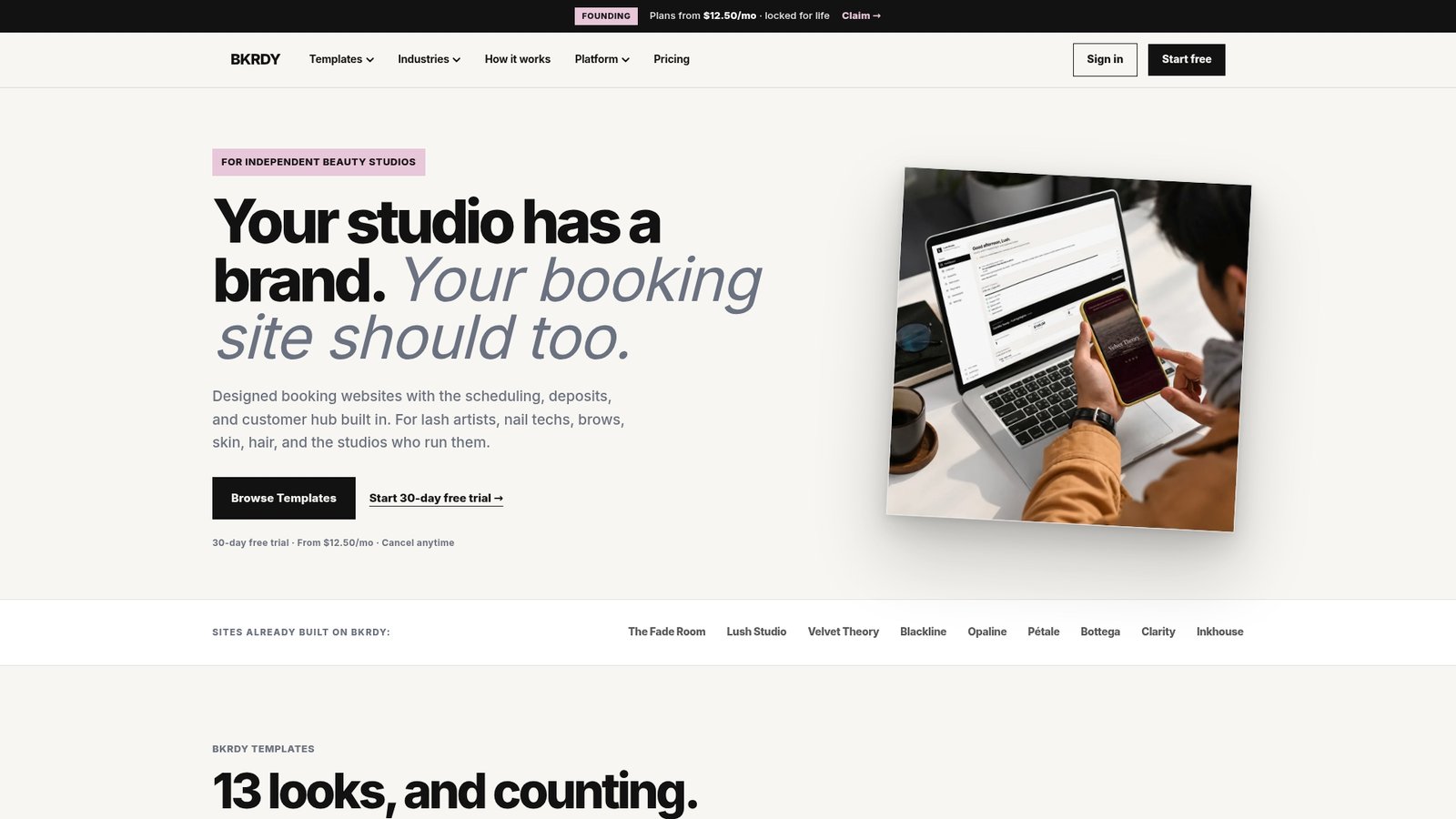
Bkrdy’s platform includes automated appointment reminders, client history tracking, and a smart waitlist that fills cancellations without manual effort. The booking experience is brand-led, so clients land on a page that looks and feels like your studio, not a third-party directory. Whether you run a hair salon, a lash studio, or a solo practice, Bkrdy gives you the tools to turn first-time clients into regulars. See the full range of booking solutions for beauty pros and find the setup that fits your business.
A rebooking rate of 40-65% is the industry benchmark for strong client retention. Elite studios consistently exceed 65% by making the rebooking ask a standard part of every checkout.
Most clients do not rebook because no one asked them directly. Research shows 68% of clients who leave without pre-booking never return, typically because they forget or find a more convenient option.
Assumptive language works best. Offer two specific time options rather than asking an open-ended question. Saying “I have Tuesday at 2pm or Thursday at 10am, which works?” produces far better results than “Would you like to book again?”
Automated reminders sent at approximately 80% of the client’s average service interval hit the optimal timing. For a six-week service cycle, that means a reminder around week five, when the need is real and the calendar is still open.
Track your rebooking rate monthly by dividing clients who rebooked by total appointments, then multiply by 100. Break this down by stylist to identify coaching opportunities and measure improvement over time.
BKRDY
Pick a template, take deposits, and let clients book on your own branded site. 30-day free trial.
Start your 30-day trial