
Blog
Discover the role of pricing transparency in hair bookings to build client trust. Learn how clear pricing can boost loyalty and confidence.
Pricing transparency in hair bookings is defined as openly communicating all service costs, variables, and policies before a client confirms an appointment. The role of pricing transparency in hair bookings goes far beyond listing a number on a menu. It sets expectations, prevents disputes, and signals to clients that your salon operates with integrity. Research links price transparency to loyalty and perceived fairness, making it one of the most direct levers a salon owner has for improving client retention and booking confidence.
Transparent pricing is not just a courtesy. It is a trust mechanism. The TEFL model (Transparency, Ethics, Fairness, and Loyalty) identifies price fairness and transparency as direct drivers of customer loyalty in service businesses, including hair salons. When clients know what they will pay before they sit in the chair, they associate your salon with fairness and respect.
“Pricing transparency provides fairness and ethical clarity, framing pricing as respectful and predictable, especially for variable-price services like color and extensions.” - TEFL Model, Emerald Publishing
The psychological effect of clear pricing is real. Clients who receive a price range with clear explanations feel more in control of their decision. That sense of control reduces anxiety and increases the likelihood they will book again. Clients who feel surprised by a final bill, even once, rarely return.
Clear pricing also shapes how clients perceive your professionalism before they ever walk through the door. A booking page that lists a color service as “$120 and up” with no explanation reads as evasive. A page that states “$120-$200 depending on hair length and density” reads as honest and organized. The difference in client perception is significant.
The most practical approach to clear pricing in hair salons is the “starting at” model paired with explicit price drivers. Rather than listing a flat rate that may not apply to most clients, salons publish a base price alongside the variables that affect the final cost. Those variables typically include hair length, density, and service complexity.
Rachel’s Hair Salon in Mesa, Arizona, uses a structured pricing questionnaire to tie price variations to measurable factors clients can assess themselves before booking. This approach removes guesswork and sets a clear expectation before the consultation even begins. Clients arrive knowing their hair length and density will affect the final price, so the number at checkout rarely surprises them.

Deposit and cancellation policies are the second layer of pricing transparency that salons often underestimate. Dream Hair Studio and Koko Hair & CO both publish 48-hour cancellation notice requirements with explicit deposit forfeiture rules. Clients who read these policies before booking understand the financial commitment they are making. That clarity reduces no-shows and last-minute cancellations.
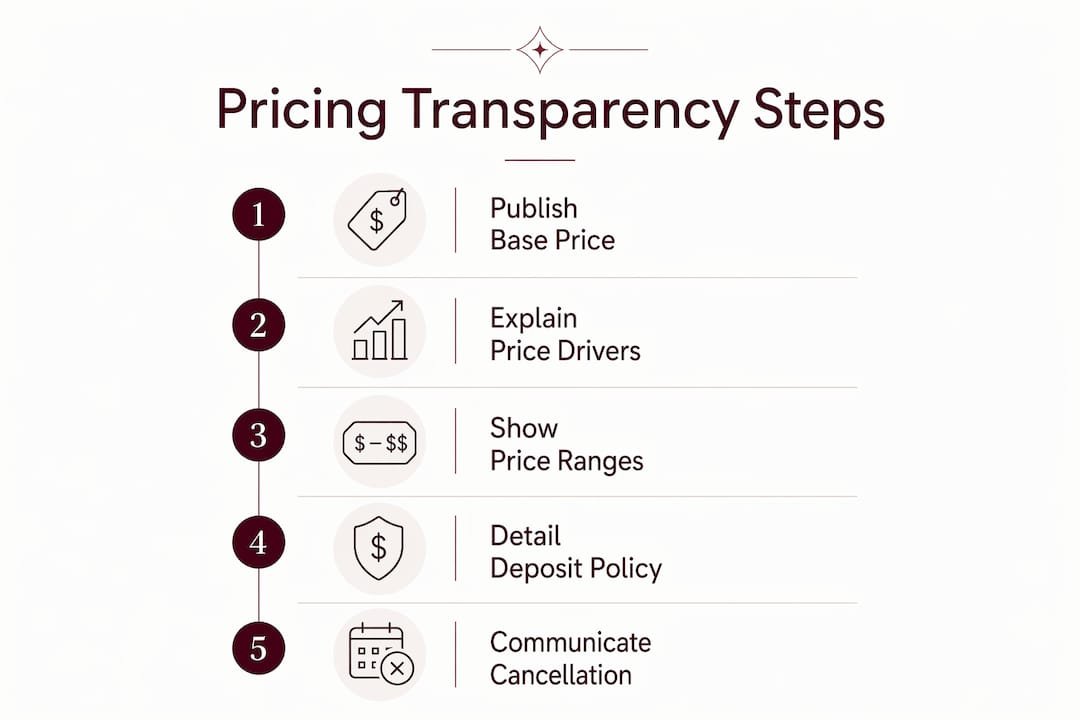
Here is a practical structure for communicating pricing across your booking funnel:
| Pricing element | What to communicate |
|---|---|
| Base service price | Starting rate for standard hair length and density |
| Price range | Upper limit based on complexity or length |
| Deposit amount | Fixed dollar amount or percentage of service cost |
| Cancellation deadline | Hours of notice required before forfeiture applies |
| Add-on costs | Individual prices for toners, treatments, or extensions |
Pro Tip: Add a one-sentence explanation next to every price range on your booking page. Something like “Price varies based on hair length and density, confirmed at consultation” removes ambiguity without requiring a lengthy disclaimer.
Inconsistent pricing is one of the fastest ways to lose a client’s trust. When a client sees $95 on your booking page, receives a confirmation email showing $95, and then gets charged $130 at checkout, the experience feels like a bait-and-switch. That perception is nearly impossible to recover from.
Price management consistency across all client-facing channels is a recognized standard in service businesses. When your booking platform, confirmation messages, and point-of-sale system all display the same price information, clients experience no friction between expectation and reality. That alignment is what builds long-term confidence in your salon.
The practical risk of inconsistency goes beyond individual client complaints. Clients who feel misled share that experience. A single checkout surprise can generate a negative review that affects future bookings from clients who have never visited your salon.
Pro Tip: Run a test booking on your own system every few months. Go through the full flow as a client would and check that every price shown matches what you would actually charge at checkout.
Clients fear unexpected fees. That fear is the single biggest source of friction in the hair salon booking process. Transparent pricing reduces this fear by giving clients the information they need to make a confident decision before they commit.
The booking decision for a hair service is not impulsive. Clients compare options, check prices, and weigh the cost against their budget. A salon that publishes clear, detailed pricing removes a major barrier in that decision process. A salon that hides pricing behind “call for a quote” or vague ranges creates friction that pushes clients toward a competitor who is more upfront.
Transparent pricing also improves the quality of the consultation itself. When a client arrives already knowing the price range and the factors that affect it, the consultation becomes a confirmation rather than a negotiation. That shift in dynamic makes the client feel informed and respected, not pressured.
A booking funnel that includes price at service selection, deposit terms, cancellation rules, and add-on cost explanations gives clients a complete financial picture before they confirm. That completeness is what converts a browsing client into a booked appointment.
Pricing transparency in hair salons directly increases client trust, reduces booking friction, and builds loyalty when applied consistently across every client touchpoint.
| Point | Details |
|---|---|
| Transparency drives loyalty | The TEFL model links clear pricing to fairness perceptions and repeat bookings. |
| Use structured price ranges | Pair “starting at” prices with explicit drivers like hair length and density. |
| Publish deposit and cancellation rules | Clear policies reduce no-shows and prevent post-service disputes. |
| Sync pricing across all channels | Mismatches between booking pages and checkout destroy client trust fast. |
| Pair pricing with consultation clarity | Clients who understand price variables before arriving book with more confidence. |
I have worked with enough salon owners to know that most of them believe their pricing is already transparent. They have a menu on their website. They list a starting price. They tell clients at the consultation if the cost will be higher. That feels like enough. It is not.
The gap between what a salon thinks it communicates and what a client actually understands is where most trust problems live. A client who sees “$80 and up” on a booking page and then gets quoted $160 at the consultation does not feel informed. They feel ambushed. The salon owner did nothing wrong by their own standard. But the client’s experience tells a different story.
The salons that get this right treat pricing transparency as a system, not a policy. They define the exact variables that affect price. They publish those variables where clients can read them before booking. They train staff to explain pricing in the same language every time. And they check that every platform showing their prices is current and consistent.
The other mistake I see constantly is treating deposit and cancellation policies as fine print. Clients do not read fine print. If your 48-hour cancellation rule is buried in a terms page nobody clicks, it is not transparent. It is a trap. Put it where clients cannot miss it: on the booking confirmation, in the reminder message, and on the booking page itself.
Pricing transparency is not about being cheap or giving clients ammunition to negotiate. It is about showing clients that you respect their time and their budget. That respect is what keeps them coming back.
, Luis
Salon owners who want to close the gap between what they communicate and what clients actually see need a booking system built for that job. Bkrdy’s salon booking websites are designed specifically for independent beauty studios, with built-in tools to display service price ranges, explain price variables, and attach deposit and cancellation policies directly to each service listing.
Bkrdy handles deposit collection through Stripe, sends automatic appointment reminders that include pricing and policy details, and keeps client history so returning clients always see accurate, current pricing. The setup takes hours, not weeks. For salon owners who want clients to arrive informed and confident, Bkrdy gives you the structure to make that happen without building it from scratch.
Pricing transparency in hair salons means publishing all service costs, price variables, deposit requirements, and cancellation policies where clients can read them before booking. It gives clients a complete financial picture before they commit to an appointment.
The TEFL model identifies price fairness and transparency as direct drivers of customer loyalty. Clients who feel respected and informed are significantly more likely to rebook and refer others.
Salons should publish a price range with explicit drivers such as hair length, density, and complexity. A pre-booking questionnaire, like the approach used by Rachel’s Hair Salon, ties price variations to factors clients can assess themselves before arriving.
Specify the exact notice window (typically 48 hours), the deposit amount at risk, and the conditions for a refund. Placing this information on the booking page, the confirmation email, and the appointment reminder removes any claim of surprise.
Yes. When a booking page shows one price and the checkout shows another, clients experience it as a breach of trust. Consistent price management across all client-facing systems is a recognized standard for maintaining client confidence and reducing booking abandonment.
BKRDY
Pick a template, take deposits, and let clients book on your own branded site. 30-day free trial.
Start your 30-day trial