
Blog
Unlock the power of a nail tech rebooking strategy. Boost client retention, increase revenue, and watch your salon thrive in 2026.
A nail tech rebooking strategy is the practice of systematically securing your clients’ next appointment before they leave your chair, turning one-time visits into a predictable, recurring revenue stream. Top-performing nail salons achieve rebooking rates of 69% or higher, while the industry average sits at just 30-40%. That gap is not accidental. It reflects a deliberate difference in how those salons communicate, follow up, and use their booking tools. For every 10-point gain in rebooking rate, annual revenue can grow 12-18%. The strategies in this guide close that gap.
Your rebooking rate is the percentage of clients who schedule their next appointment before or shortly after leaving your salon. It is the single clearest measure of client retention for nail technicians. A client who books again is worth far more than a new client you had to advertise to find.
Measuring it is straightforward. Divide the number of clients who rebooked in a given period by the total number of appointments completed in that same period, then multiply by 100. Track this number per technician and per service type, not just as a single salon-wide figure. A gel manicure client and an acrylic set client have different natural return cycles, so grouping them together hides useful information.

The business case for tracking rebooking rates closely is strong. Rebooking builds predictable revenue and reduces your dependence on constantly acquiring new clients. When you know that 60% of your clients will return within three weeks, you can plan staffing, supplies, and cash flow with real confidence.
| Rebooking rate | What it signals | Typical revenue impact |
|---|---|---|
| Below 30% | High client churn, heavy reliance on new clients | Unpredictable monthly income |
| 30-40% | Industry average, room for significant growth | Moderate stability |
| 50-60% | Above average, strong retention habits in place | Noticeably more consistent revenue |
| 69%+ | Top-performer benchmark | 12-18% revenue lift per 10-point gain |
Use your client preference tracking data to segment these numbers by service. You will quickly see which services have the lowest return rates and where to focus your energy first.
Timing the rebooking ask correctly removes almost all of the awkwardness nail techs dread. The best moment to ask is during the top-coat application or while the polish is curing. Clients are relaxed, their hands are occupied, and the conversation flows naturally. Asking at checkout, by contrast, feels transactional because the service is already over.
The phrasing matters just as much as the timing. Frame the rebooking as an expert recommendation, not a sales question. Compare these two approaches:
The second version works because it frames the question as an assumption with specific dates and options rather than an open yes/no. Clients respond to specificity. When you name the date and explain why it matters, you are acting as an expert advisor, not a salesperson.
Position yourself as the authority on your client’s nail health. Phrases like “your nails will need a fill in about three weeks” or “this set looks best at the four-week mark” give clients a concrete reason to return on schedule. That framing makes rebooking feel like maintenance advice, not a pitch.
Pro Tip: If a client hesitates, say “I can hold that spot for you and send a reminder closer to the date.” This removes the pressure of committing while still moving them toward a booking.
Rebooking prompts and client retention work best when they feel like a natural extension of the service conversation. Practice the phrasing until it sounds like you, not a script.
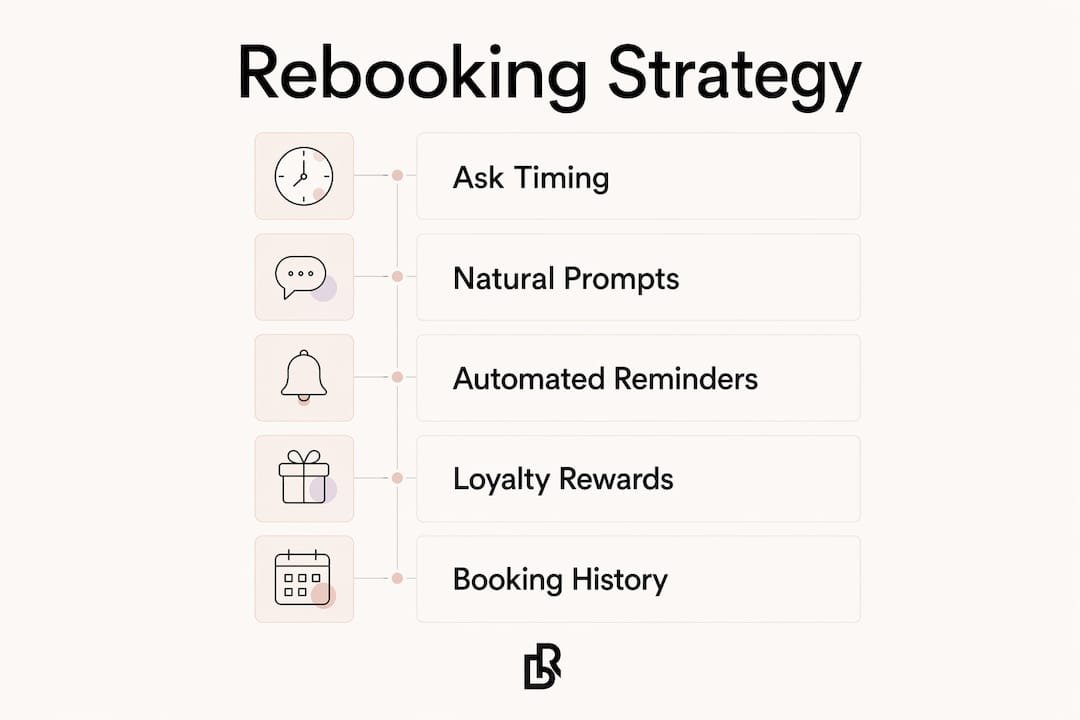
Clients do not skip rebooking because they dislike you. They skip it because life gets busy. Life’s busyness causes clients to forget to rebook, and timely reminders with easy booking links solve this directly. The fix is not more persuasion. It is better timing and lower friction.
Send rebooking reminders at roughly 80% of the client’s typical service interval. For a six-week gel service, that means a reminder at week five, not week six. Reminders sent at this point catch clients before their schedule fills up and before their nails visibly deteriorate. A reminder that arrives after the nails have already grown out is too late.
The channel matters too. Push notifications from digital loyalty cards carry roughly 90% open rates, compared to about 20% for emails. That is not a small difference. If your reminder system relies only on email, you are reaching fewer than one in five clients. Pair email with SMS or push notifications for real coverage.
Structured nail salon loyalty programs increase retention by up to 23% when they reward frequency rather than just discounts. Three models work well for independent nail techs:
Referral incentives work as an accelerant on top of any of these models. Offer a small reward to both the referring client and the new client. This turns your most loyal clients into your most effective marketing channel.
Pro Tip: Digital wallet passes (Apple Wallet or Google Wallet) let clients carry their loyalty card on their phone. They also allow you to send push notifications directly to that card, making them far more effective than paper stamp cards.
Pair your reminder system with appointment reminder tools that trigger automatically based on each client’s last visit date. Manual follow-up does not scale.
Your booking history is one of the most underused tools in a nail tech’s business. Every completed appointment is a data point that tells you when that client is likely to need their next service, what they prefer, and how they have responded to reminders in the past. Using that data turns rebooking from guesswork into a repeatable process.
Start by reviewing your digital client records to identify patterns. Which clients consistently return every three weeks? Which ones stretch to five or six? Knowing this lets you time your outreach precisely rather than sending the same reminder to everyone on the same schedule.
Tracking rebooking rates by stylist and service type reveals where the gaps are. Displaying individual rebooking rates to technicians can increase average rates by 10 percentage points within 90 days. That is a meaningful shift from a single change in how you present data.
Cancellation recovery is where most nail techs leave money on the table. Same-day follow-up texts after cancellations recover 40-50% of those appointments, compared to just 10-15% without follow-up. A simple message sent within hours of a cancellation, offering two alternative time slots, does most of the work.
A practical 30-day action plan to put this into motion:
| Action | Expected outcome | Timeline |
|---|---|---|
| Track rebooking by service type | Identify lowest-performing services | Week 1 |
| Set interval-based reminders | Reduce no-shows and lapsed clients | Week 2 |
| Launch digital loyalty program | Up to 23% retention increase | Week 3 |
| Implement cancellation recovery texts | Recover 40-50% of lost appointments | Week 4 |
Use online booking tools that log client history automatically. Manual record-keeping breaks down the moment your schedule gets busy.
A consistent nail tech rebooking strategy built on expert timing, automated reminders, loyalty rewards, and booking history data is the most direct path to predictable salon revenue.
| Point | Details |
|---|---|
| Rebooking rate benchmark | Top performers hit 69%+; the industry average is 30-40%. |
| Best timing for the ask | Ask during top-coat application, not at checkout, for the most natural response. |
| Reminder timing | Send rebooking reminders at 80% of the service interval for best results. |
| Loyalty programs | Structured programs increase retention by up to 23% when they reward frequency. |
| Cancellation recovery | Same-day follow-up texts recover 40-50% of canceled appointments. |
Most nail tech rebooking advice focuses on scripts and tools. Those matter. But the deeper issue is that rebooking has to become a reflex, not a decision you make appointment by appointment.
I have watched talented nail techs with genuinely loyal clients lose them to competitors, not because of price or skill, but because they never made rebooking a consistent part of their service. The client liked them. They just did not make it easy or obvious to come back. That is a fixable problem, and it has nothing to do with being pushy.
The techs who consistently hit 60% or higher rebooking rates treat the rebooking ask the same way they treat the top-coat step. It is part of the service, every single time, without exception. They do not decide whether to ask. They just ask.
The other thing worth saying plainly: your clients want to be guided. They are not nail experts. When you say “your nails will look best if you come back in three weeks,” most clients feel taken care of, not sold to. That is the mindset shift that makes everything else in this guide work.
, Luis
Nail techs who want to put these strategies into practice need a booking setup that works for them automatically, not one that creates more manual work.
Bkrdy builds booking websites for nail techs that include built-in client profiles, automated appointment reminders, and deposit handling through Stripe. Every client account stores booking history, so you always know when someone is due for their next visit. The platform sends reminders on your behalf, handles reschedules, and keeps your calendar full without you chasing clients down. If you want a booking setup that actively supports your rebooking rate, Bkrdy is built for exactly that.
A rebooking rate of 69% or higher marks a top-performing nail salon, while the industry average falls between 30-40%. Reaching 50% is a realistic near-term goal for most independent nail techs.
Clients forget because life gets busy, not because they are unhappy. Automated reminders sent at roughly 80% of the service interval, combined with easy one-tap booking links, resolve this reliably.
The best moment is during the top-coat application or while the polish is curing. Clients are relaxed and receptive at this point, making the ask feel like a natural part of the service.
Booking history lets you time reminders precisely to each client’s actual return pattern, personalize your outreach, and identify which services have the lowest rebooking rates so you can address them directly.
For every 10-point gain in rebooking rate, annual revenue can increase by 12-18%. That makes improving your rebooking rate one of the highest-return actions available to an independent nail tech.
BKRDY
Pick a template, take deposits, and let clients book on your own branded site. 30-day free trial.
Start your 30-day trial