
Blog
Discover how a booking website builds brand identity to enhance client trust and boost revenue. Learn the key strategies for success.
A booking website builds brand identity by consistently applying your studio’s visual style, tone, and personality across every client interaction point, from the first page view to the confirmation email. Brand identity, in the industry sense, is the cohesive system of visual and verbal signals that tells clients who you are before you say a word. For beauty professionals, that system lives or dies at the booking stage. Consistent brand presentation across channels can increase revenue by up to 33%. That number reflects something real: when clients feel confident in your brand, they book without hesitation.
Visual branding is the deliberate use of logo, color, typography, imagery, and layout to create a consistent impression across every screen a client sees. For booking sites, that definition gets specific fast. A client who lands on your booking page after seeing your Instagram feed should feel like they never left your world.
The five core visual elements work together as a system:
Inconsistent visuals break trust at the worst possible moment. A client who hits a booking page that looks nothing like your website starts wondering whether they are in the right place.
Pro Tip: Build a one-page brand reference document with your exact hex color codes, font names, and logo file versions. Share it with anyone who touches your booking setup so every update stays on brand.

Visual branding gets clients to the booking page. Brand voice keeps them there and brings them back. Voice is the personality behind every word your booking system uses, from the button that says “Reserve my spot” to the email that confirms their appointment.
A warm, confident studio voice sounds very different from a cold, generic one. Compare “Select a service” with “What are we doing for you today?” Both ask the same question. One feels like a form. The other feels like your studio. The difference in client experience is significant, and it costs nothing extra to get right.
Strong brand voice in booking systems covers four areas:
The pitfall most studios fall into is letting their booking platform write the copy for them. Default system text is designed to be neutral, which means it is designed to sound like nobody in particular.
Pro Tip: Write out your brand voice in three adjectives, such as warm, confident, and polished. Then read every piece of microcopy in your booking flow and ask whether it sounds like those three words. Rewrite anything that does not.
The booking engine is the highest-stakes brand touchpoint in your entire digital presence. It is the moment a client moves from browsing to committing. Brand inconsistency at the booking stage reduces trust and increases price sensitivity. That means clients who hit a generic booking interface start questioning whether the price is worth it, even if they were ready to book a minute earlier.
The financial case for a branded booking experience is straightforward. Direct bookings through your own website eliminate third-party commission fees. Commission fees on third-party platforms range from 3% to 15% per booking. For a studio doing $8,000 a month in services, that is $240 to $1,200 walking out the door every month.
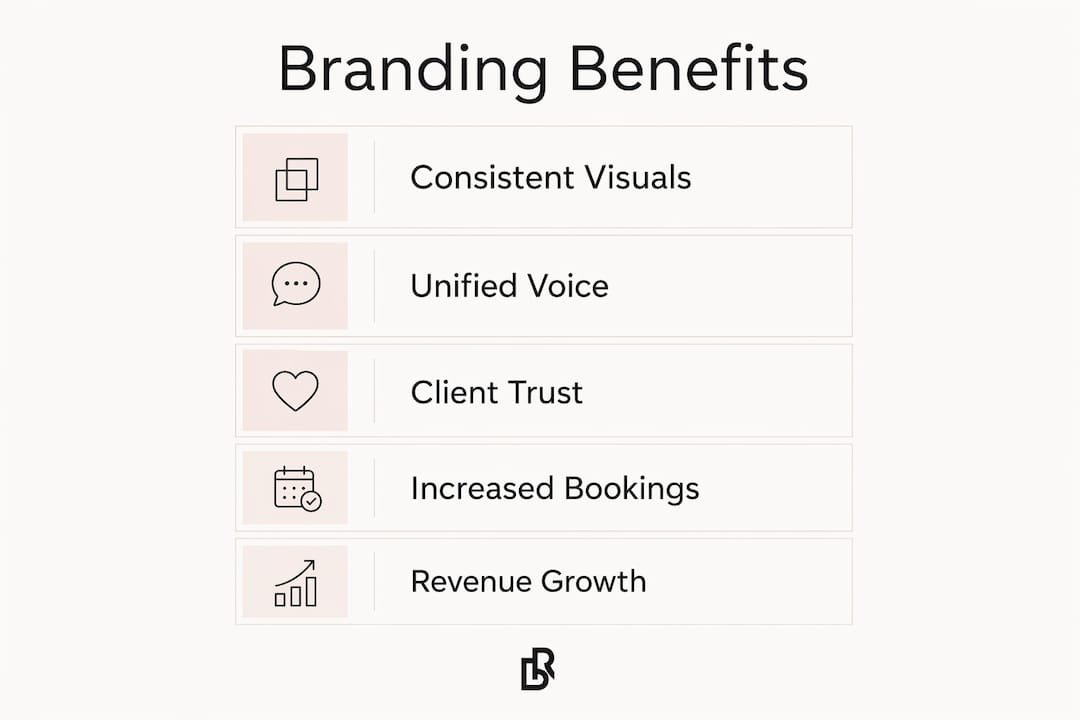
Here is what branding continuity does at the booking stage:
| Branding element | Impact on client behavior |
|---|---|
| Consistent color and logo | Confirms the client is still in your studio’s world |
| Branded microcopy | Reduces hesitation and builds emotional connection |
| Studio photography on booking pages | Reinforces service quality and sets expectations |
| Branded confirmation email | Lowers post-booking anxiety and increases show rates |
| Consistent typography | Creates a calm, professional reading experience |
Consistent visual language across the live booking flow, payment interface, and confirmation reassures clients. The booking site becomes an emotional extension of your studio, not just a utility. That emotional connection is what separates a one-time client from a loyal regular.
Pro Tip: Walk through your own booking flow as if you were a new client. Note every moment where the visual style or tone shifts. Each one of those moments is a trust leak you can fix.
Most studios treat their booking page as a back-office tool rather than a brand asset. That single assumption causes most of the branding problems we see in beauty businesses.
Treating the booking page as separate from your website. Your booking page is not a utility attached to your brand. It is your brand. Unified branding across all touchpoints from social to email strengthens your professional promise. A booking page that looks like a different business breaks that promise at the worst moment.
Using default templates without customization. Generic booking templates are designed to work for everyone, which means they work perfectly for no one. A nail tech in Brooklyn and a med spa in Scottsdale should not have the same booking page. Customizing your booking page design is not optional if brand identity matters to you.
Inconsistent fonts, colors, or logos across the booking flow. This is the most common and most fixable mistake. It usually happens when different tools are stitched together without a brand reference document. The fix is simple: document your brand standards and apply them to every tool.
Ignoring the confirmation email. The confirmation email has one of the highest open rates of any message you send. Most studios waste it with a plain-text system default. A branded, warm confirmation email is a free loyalty tool.
Fragmented client experience. When a client moves from your Instagram to your website to your booking page and each step feels slightly different, the cumulative effect is doubt. Doubt kills bookings.
Pro Tip: Audit your booking flow quarterly. Screenshot every step and lay them side by side. Visual inconsistencies that are invisible in daily use become obvious when you see them together.
Building a branded booking experience does not require a design degree or a large budget. It requires clarity about who you are and the discipline to apply that consistently.
The studios that build the strongest booking brands are not the ones with the biggest budgets. They are the ones who treat every client touchpoint as a deliberate choice.
A booking website builds brand identity by applying consistent visual and verbal signals across every client touchpoint, from the first page view to the post-booking confirmation email.
| Point | Details |
|---|---|
| Visual consistency drives revenue | Consistent branding across booking touchpoints can increase revenue by up to 33%. |
| Voice matters as much as visuals | Branded microcopy and confirmation emails reduce client anxiety and build loyalty. |
| Booking engine is highest-stakes | Brand inconsistency at the payment stage increases price sensitivity and drops conversions. |
| Direct bookings save real money | Eliminating third-party platforms removes commission fees ranging from 3% to 15% per booking. |
| Audits reveal trust leaks | Quarterly booking flow audits catch visual and tonal inconsistencies before they cost you clients. |
Here is something I have noticed after years of watching beauty studios build their online presence: most owners spend months perfecting their Instagram grid and then send clients to a booking page that looks like a government form. The disconnect is jarring. And clients feel it, even if they cannot name it.
The booking page is where your brand has to do its hardest work. A client who is about to hand over a deposit is not in browse mode anymore. They are in trust mode. Every visual and verbal signal on that page either confirms their decision or introduces doubt. There is no neutral.
What I have seen work consistently is treating the booking experience as an extension of the studio’s physical space. The same calm, the same palette, the same voice that greets a client at the door should greet them on the booking page. Studios that get this right see fewer abandoned bookings and stronger client retention, not because they spent more on design, but because they were more intentional about it.
The uncomfortable truth is that a generic booking link is a brand statement. It says your booking process is an afterthought. A branded booking website says the opposite. It says every detail of your client’s experience has been considered. That message lands before a single appointment is made.
, Luis
Beauty professionals deserve a booking website that reflects the quality of their work, not a generic scheduling link that could belong to anyone.
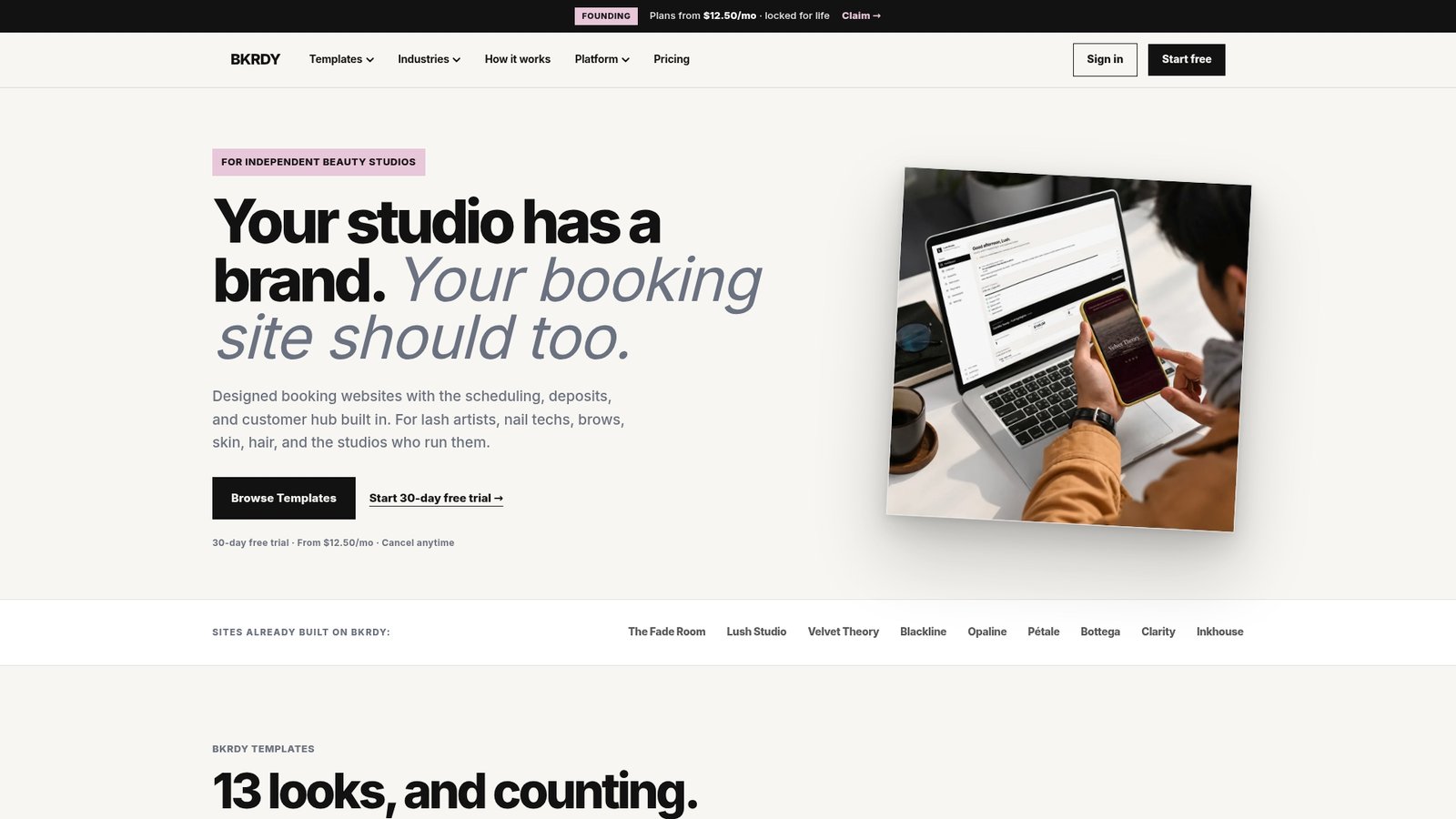
Bkrdy builds fully designed booking websites for lash artists, estheticians, nail techs, hairstylists, and spas, with your colors, your fonts, your photography, and your voice built in from the start. The platform includes built-in scheduling, deposit handling through Stripe, client history management, automatic reminders, and a smart waitlist. No third-party commissions. No generic templates. No lengthy setup. Your booking site should feel like the front door to your studio. Bkrdy makes sure it does.
Visual branding on a booking site is the consistent use of your logo, color palette, typography, and imagery across every page of the booking flow. Consistent visual branding across all touchpoints can increase revenue by up to 23%.
Booking pages communicate brand style through color choices, font selection, photography, button copy, and the overall layout rhythm. When these elements match the rest of your studio’s digital presence, clients feel confident and are more likely to complete a booking.
Brand identity at the booking stage reduces price sensitivity and builds trust at the moment a client is making a financial commitment. Studios with consistent branding across their booking experience see higher conversion rates and stronger client retention.
Start with a brand kit that documents your logo files, hex color codes, typefaces, and voice guidelines. Then apply those standards to your booking pages, confirmation emails, and reminder messages without exception.
A branded booking page removes the visual cues that make clients feel they are on a third-party platform, which reduces hesitation and increases direct bookings. Direct bookings also eliminate commission fees ranging from 3% to 15% per transaction.
BKRDY
Pick a template, take deposits, and let clients book on your own branded site. 30-day free trial.
Start your 30-day trial