Blog Running the week
How many clients a day is too many?
The number of clients you can do in a day is not the number of appointments that fit between opening and closing. It is lower, and the space between those two numbers is where most owners quietly wear themselves out.
Almost nobody works their ceiling out in advance. You find it by crossing it. There is a Saturday you still remember where you stopped being good at your job around four o'clock. That day is your data, and your number is just underneath it.
Your calendar is measuring the wrong thing
A calendar answers one question: how many service blocks fit in the day. Eight fit, so eight get booked.
But a client is not a service block. Each one also brings the messages before, the notes after, the rebooking conversation, the payment, and the reset of your station. None of that is in the slot, and all of it is in your day.
To see it, spend one week noting the minutes every time you do something for a client outside their appointment. Answering a booking message, chasing a deposit, writing up a set, moving someone, cleaning between clients. Two words and a number in your phone.
Add it up and divide by the days you worked. That is your admin block: the second job you already do for free.
The slot holds the service. The day holds everything else.
The signs you have already crossed it
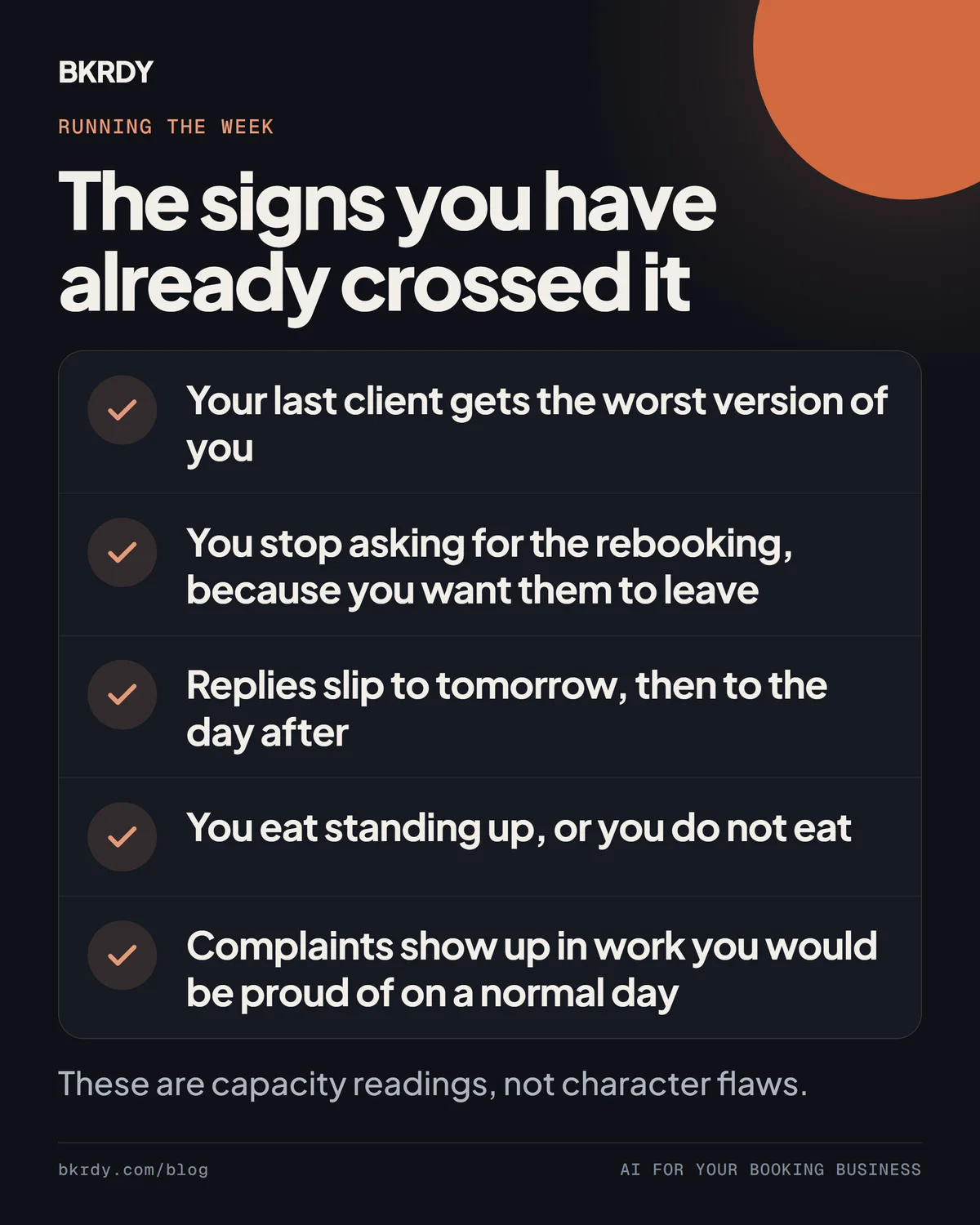
Read these honestly. They are capacity readings, not character flaws.
- Your last client gets the worst version of you. Same hands, less attention, and you both feel it.
- You stop asking for the rebooking, because asking extends the conversation and you want them to leave.
- Replies slip to tomorrow, then to the day after, then someone books elsewhere because they never heard back.
- You eat standing up, or you do not eat.
- Complaints show up in work you would be proud of on a normal day.
Work out your own number
- Start with the hours you will actually work. Not your opening hours. The hours you are genuinely willing to be on your feet, including setup before the first client.
- Subtract the admin block you just measured. That time is already spoken for. Pretending otherwise is how the day ends at nine o'clock.
- Divide by the real length of your service, including turnaround. The honest number, with the six minute late arrival and the chat at the end in it.
- Subtract one.
Subtract one anyway. The last slot of a full day is almost never worth what it costs: it is the one you rush, the one that runs over, and the one that pushes your admin into your evening. You pay for it twice and charge for it once.
If your days vary, run the sum per day type. A day of full sets and a day of fills are two different businesses, and lashing has a scheduling shape all of its own.
Some ceilings are physical and the arithmetic cannot see them
The sum above assumes you are the same person at five o'clock as at nine. In some trades the gap is wide.
A lash artist works at magnification with their hands steady and their eyes fixed at one distance, and the isolation slows whether the calendar agrees or not. A barber stands all day with their shoulders up and their back loaded. A massage therapist uses their whole body as the tool, so a sixth deep tissue hour is a question of physical output, not scheduling.
The ceiling on physical work is lower than the arithmetic suggests, and reaching it is not a failure of effort. A body repeating one motion all day gets slower, and the work shows it before you feel it.
At your ceiling, the honest lever is price
If your day is genuinely full at your real number, volume is finished as a growth strategy. One way is left to earn more, which is to earn more per appointment.
Easy to write, horrible to do. It means a message you will put off sending, a few clients who will not come back, and a week of wondering whether you misjudged it.
Still, compare them at the same scale. An extra appointment earns one service fee at the cost of everything around it. A price rise applies to every appointment on every day and costs your body nothing. If you are weighing it against hiring, the growth options compare more clearly on paper than in your head.
Cap it in the booking system, not in your willpower
A number you have decided on is not a cap. A cap is a number that something other than you enforces. Thursday comes, your regular asks for the one day that is full, they ask nicely, and you like them. You will say yes, and the cap you set on Sunday will not survive the week. Closing the day before anyone asks is the only version that holds, and it is not personal when the booking page says it.
BKRDY has a daily cap you can set for the whole business, plus a cancellation waitlist that offers a freed slot to the people already waiting. The settings matter less than the number you pick.
The trade-off, straight: a cap turns away work. On the day you would have squeezed someone in, it costs you a real service fee. You are choosing that on purpose, for the sake of the other seven appointments. And if your book is thin it is the wrong trade. A cap protects a full day and does nothing for an empty one except keep it empty.
The reply when you are at your cap and someone asks for a full day
Questions
How many clients a day can one person realistically do?
There is no number worth copying from anyone else, because it depends on your service length, your turnaround and how physical the work is. Run the sum on your own week: hours you will actually work, minus client admin, divided by your true service length, minus one.
Should I count admin as part of my capacity?
Yes, and it is the step most people skip. The messages, notes, rebooking and payments are real hours you already work. Subtract them before you divide up the day, or what you have planned is a schedule plus an unpaid evening shift.
Is it better to see fewer clients at a higher price?
If your days are genuinely full, yes, because volume has run out and price is the only lever left. If your days are not full, no. Raising prices into a thin book usually makes it thinner. The work there is getting the right clients in, not protecting a capacity you have not reached.