Blog Running the week
Double booking: the mistake and the technique
Double booking means two completely different things, and one of them is a mistake while the other is a skill. If you have just found two clients in the same 2pm, go to the one calendar section below. If someone told you to start double booking to earn more, the answer is yes for a few services and no for most.
The same phrase covers both, which is why the advice contradicts itself. One is your system failing. The other is deliberate scheduling under narrow conditions.
The mistake and the technique are opposites
The mistake is two clients in the same time without you meaning it. It almost never happens because you forgot, but because bookings arrive from two places that do not talk to each other: a DM and a booking page, a walk in written on paper and an online slot, or a work calendar and a personal one where your daughter's recital lives. Both are right about their own half. Neither can see the other.
The technique is choosing to overlap two clients so you work on one while the other processes. A colour developing. Lash adhesive curing. A peel sitting. Those minutes already exist and the client is paying for them either way. Using them is skilled scheduling, not greed.
Write out the minutes and mark which ones need you
Here is the test. Take one service and write its timeline in five minute blocks. Next to each, mark whether it needs your hands or your attention. Not whether it needs to happen. Whether it needs you.
Then look for an unbroken run of the blocks that do not. Fifteen or more consecutive minutes where the client needs nothing from you is a real gap, and a second client fits inside it. Dead time scattered in five minute pieces between things you have to check is not a gap, it is breathing room, and filling it will make you late.
Colour processing for thirty five minutes is a gap. A balayage where you check the lift every few minutes is not. The unbroken run is the thing, not the total.
Scattered dead time is not spare capacity. Only unbroken dead time is.
The second service also has to finish inside the gap, and the hands-on moments of the two must never land together.
Where overlapping reliably fails
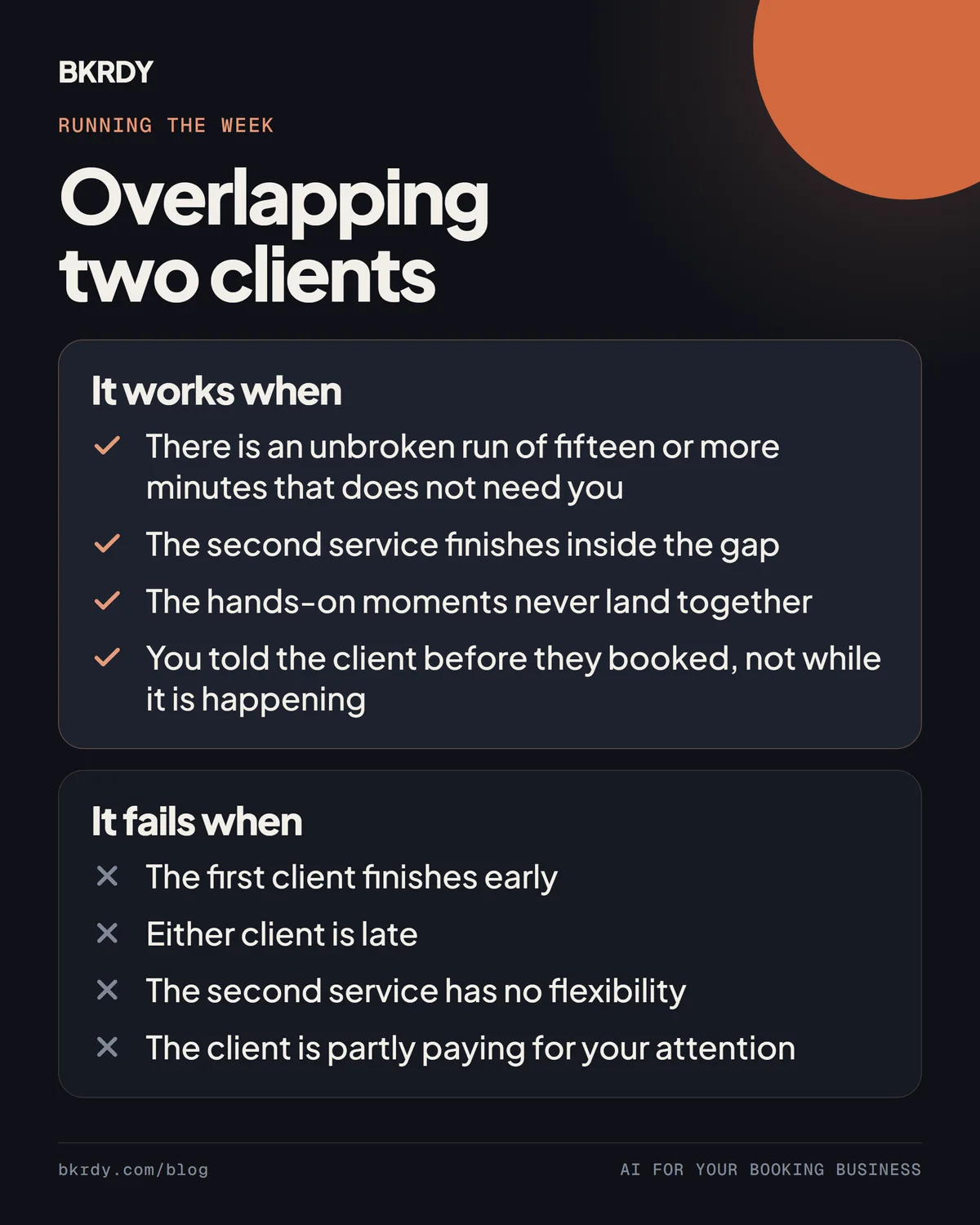
- The first client finishes early. Processing comes out faster than expected and they are in your chair while you are elbow deep in someone else.
- Either client is late. Overlap has no slack by design. A client ten minutes late does not cost you ten minutes, they cost you the whole overlap, because the gap has moved.
- The second service has no flexibility. A brow wax can wait four minutes. A gel removal mid soak cannot. Two rigid schedules can both break instead of one.
- The client is partly paying for your attention. A facial, a first consultation, a bridal trial. When the experience is most of the price, overlapping sells something you did not mean to sell.
That last one deserves saying honestly. A client who watches you walk away mid appointment can read it as being the cheaper booking, and your intentions are not visible from the chair. How you set the expectation up front is most of the difference between overlap working and costing you a regular.
Tell them before they book, not while it is happening. "Your colour processes for thirty minutes, and I use that time with another client. I'm back the moment it's ready." Said in advance, that is a professional running a tight book. Discovered in the moment, it is being dropped. Same minutes, different client.
Short frequent visits suit overlap better than consultative work, and lash artist scheduling best practices covers how those gaps fall.
For the accidental kind, one calendar is the whole answer
Every booking channel has to write into the same calendar: your booking page, your DMs, the phone, the walk in, and your own life. If one lives somewhere else, a clash is not bad luck, it is a matter of time.
In practice that is three habits. DM bookings get entered the moment you agree to them. Personal commitments go in as blocked time rather than living in your head. And your booking page is where clients are sent by default, so the DM is the exception. BKRDY keeps one calendar for every channel and does not read your personal calendar, so block the dentist appointment in BKRDY too, and that slot closes on your booking page. Once that is true, you are the only person who can create an overlap.
The first ten minutes after a real clash
Move fast. Every minute you wait is a minute closer to them leaving the house.
- Decide who you move. Whoever booked second, unless the service lengths make that obviously wrong. Not whoever you are least nervous to call.
- Call, do not text. A text reads as a brush off and starts a negotiation while the clock runs. A call is thirty seconds.
- Offer a specific time. "What works for you?" hands them a problem. Two concrete options keep it small.
- Know what you are giving before you dial. Set the standard now, while nothing has gone wrong: a percentage off, a free add on, whatever fits your prices.
The phone call when a booking clash means moving a client
No explanation of how it happened, no blaming your booking app. The client wants a new time and to know it is handled.
Then write down which channel the second booking came from, because that is the gap to close. If clashes and late cancellations are both eating your week, reducing no-shows is the other half.
Questions
Is double booking clients unprofessional?
The accidental kind is a mistake, and the call you make is what the client remembers. The deliberate kind is normal in colour, lashes and treatments with real processing time. It only becomes a problem when a client is surprised by it, so say so at booking.
How do I know if my service has enough dead time to overlap?
Write the service out in five minute blocks and mark which need your hands. Look for an unbroken run of fifteen minutes or more that does not. Scattered idle minutes between checks do not count, because you cannot leave the room four minutes at a time.
Who should I move when there is a clash?
Usually whoever booked second, since the first booking is the one you genuinely promised. Override that only when the lengths make it clearly better, for example when moving a thirty minute appointment saves a three hour one. Decide the rule now, so you are not choosing based on who is easier to call.