Blog Switching
Free salon booking software, and what free costs
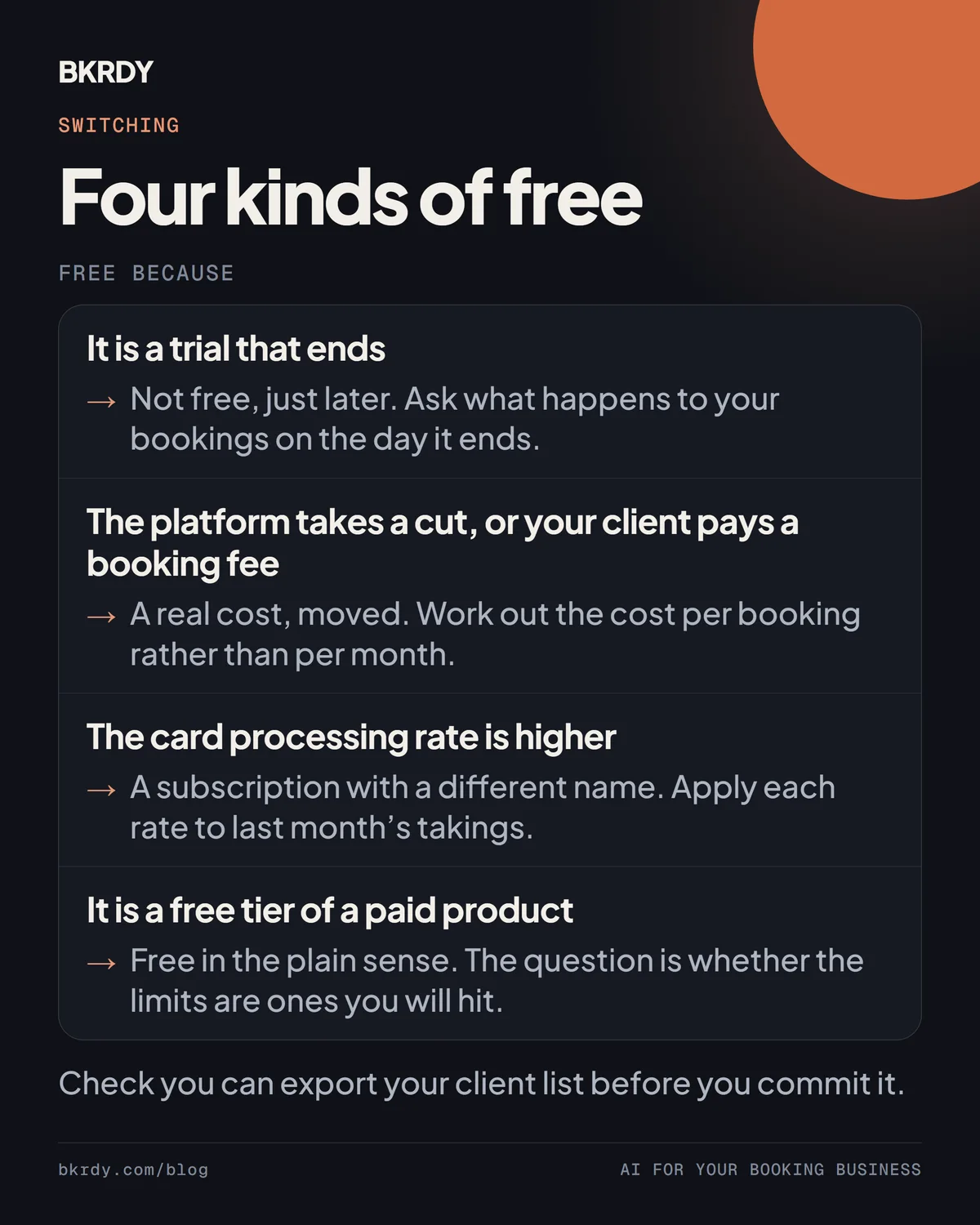
Free salon booking software is real, and some of it is good. What matters before you move your client list onto it is where the money comes from, because it comes from somewhere. Four arrangements all get called free, and each charges you somewhere different.
A free trial is not free, it is just later
A thirty day trial is a good way to see software. It is not a free plan, whatever the ad says. The useful question is what happens on the day it ends:
- Does your booking page stay up, or go dark?
- Do appointments already booked survive, or do you lose next month's Tuesdays?
- Do reminders keep sending? You find this one out through a no-show, not a warning.
- Can you export your client list yourself after the trial has lapsed?
Do this week: put your trial's end date in your phone with a two day warning, and note the card it will charge.
Free because your client pays, or because the platform takes a cut
Marketplaces are free to join because they get paid per booking instead of per month. Either the platform keeps a percentage of bookings that came through its own search results, or your client pays a booking fee on top of your price. Both are real costs. They have just moved.
A subscription is a number per month and a commission is a number per booking, so convert before you compare. Find the percentage on the company's own page, apply it to your real prices, then multiply by how many of those bookings come through them a month. A cut of a $45 beard trim and a cut of a $280 full set are not the same decision.
A commission is not cheaper than a subscription. It is a subscription whose size depends on how well you are doing.
A higher card rate is a subscription with a different name
This is the most common free plan in beauty software and the easiest to under-read. The plan costs nothing, and card payments process at a higher rate than on the same company's paid plans. Nothing is hidden, it is just in small grey text.
A percentage point sounds like nothing until you put your own takings behind it. These are illustrations, not anybody's rates:
| A month's card takings | What one percentage point of difference costs |
|---|---|
| $2,000 | $20 a month |
| $6,000 | $60 a month |
| $12,000 | $120 a month |
Do it with your numbers. Take last month's card takings, apply each plan's rate, subtract, then compare the gap with the subscription you avoided. If the gap is bigger, the free plan is the expensive one, and it grows as you do.
A free tier with limits is the honest kind of free
A free tier of a paid product is free in the plain sense. No commission, no inflated card rate, no end date.
So the honest question is whether the limits are ones you will hit, and what happens when you do. Some free tiers stop and wait. Others keep working and nag. A few switch off something your clients can see, which is the only version that costs you a booking.
What free plans almost always limit
Check each against how you work, not how it sounds:
- Number of staff. Usually one. Hiring a second person is what moves most people onto a paid plan.
- Your own domain. You sit on a subdomain of theirs, so your booking link carries somebody else's name.
- Reminders. Email is usually included. Texts are often extra, capped or missing, and texts are what clients read.
- Deposits and holding a card. Frequently absent. If no-shows cost you real money, this line decides the comparison.
- How much the page can look like your business. Some free plans give you a real design. Others give you a form with your name on top.
- The platform's branding. A "powered by" line, their logo in confirmation emails, their name in the browser tab.
If you work alone, a one staff cap is a description of your business. If you hired someone in March, it is a wall with a date on it. And look at a live page before you believe a feature list.
Ask these questions before you move your client list anywhere
Send them to whoever answers sales email. How plainly they answer is itself an answer.
Questions to send a booking platform before you move your client list
Free genuinely suits some people and badly suits others
Free is the right call if you are starting out, if you take a handful of bookings a week, or if you do not know yet whether online booking changes anything for you. The cost of being wrong is small, and a booking app for solo beauty pros covers what you actually need.
It is the wrong call if you take deposits on most services, if you have staff, or if your booking page is the main shop window people judge you through. Those three run straight into the usual limits.
BKRDY's Free plan sits in the fourth category: $0, a real booking site that stays live, one calendar, four templates, no custom domain, so your link is a bkrdy.me address rather than your own. The paid plans are on the pricing page, and the booking software comparison covers the main platforms.
Questions
Is there genuinely free salon booking software?
Yes. Free tiers of paid products have no end date, no commission and no inflated card rate. What they have instead are limits, usually on staff numbers, custom domains, texts and deposits. Whether that counts as free depends on whether you need what is behind them.
Can a free plan cost more than a paid one?
Easily, and the processing rate is how. If the free plan's card rate is one percentage point higher than the paid plan's, and you take $6,000 a month on cards, that is $60 a month, more than many salon subscriptions.
Should I put my client list on a free plan?
Only if you can get it back out. Before you upload anything, find the export, run it, open the file. If there is no export, or it needs a support request, or it leaves out phone numbers, you are lending them your client list rather than storing it.