Blog Money on the table
Keeping a card on file, without the awkward part
Most owners who put off charging a no-show fee are not nervous about the fee. They are nervous about the conversation. Asking a client for $45 after they missed their Tuesday is a message you have to write, send and then live with, so the policy sits on the booking page unenforced.
A card held at booking removes that conversation, not the relationship. They agree to the condition before anything has gone wrong, and if it happens the charge goes through without either of you raising it. The policy is the explanation. The card is only the mechanism.
What "on file" actually means
The details are stored by the payment processor, not by you and not written in a notebook. What you see is the card brand, the last four digits and the expiry, which is all you need.
The part that makes it work is the agreement. At booking they are told the window, the amount, and that their card is saved for that charge, and they agree before they get the slot. That consent, given up front and in plain words, is the entire basis of the arrangement.
On paid plans, BKRDY can save the client's card at booking, with their consent, through your own Stripe account, with no markup on Stripe's own rate, and the window your page shows is the same number the client's own cancel link enforces, so the policy and the software cannot drift apart.
A card on file and a deposit solve different problems
| Deposit | Card on file | |
|---|---|---|
| At booking | Money is taken now | Nothing is taken |
| At the appointment | Comes off the balance | Nothing to come off |
| If they turn up | Already paid toward the service | Never charged |
| If they miss it | You keep what you hold | You charge the stated amount |
A deposit is right when the appointment costs you something before they arrive: anything over about two hours, and anything where you order supplies ahead like a full set, a color correction or a bridal trial. You are out of pocket whether they come or not, so nobody argues.
A card on file is right for shorter repeat services. A 45 minute fill every three weeks, a beard trim, a brow wax. Asking a regular of two years to pay up front for a $60 service feels like you have stopped trusting them, and they will feel it. A card on file asks for nothing. It only means the slot is not free to walk away from inside 24 hours.
Most books run both, split by service length. Set the amount first with a no-show fee policy.
Say it once, and do not apologise
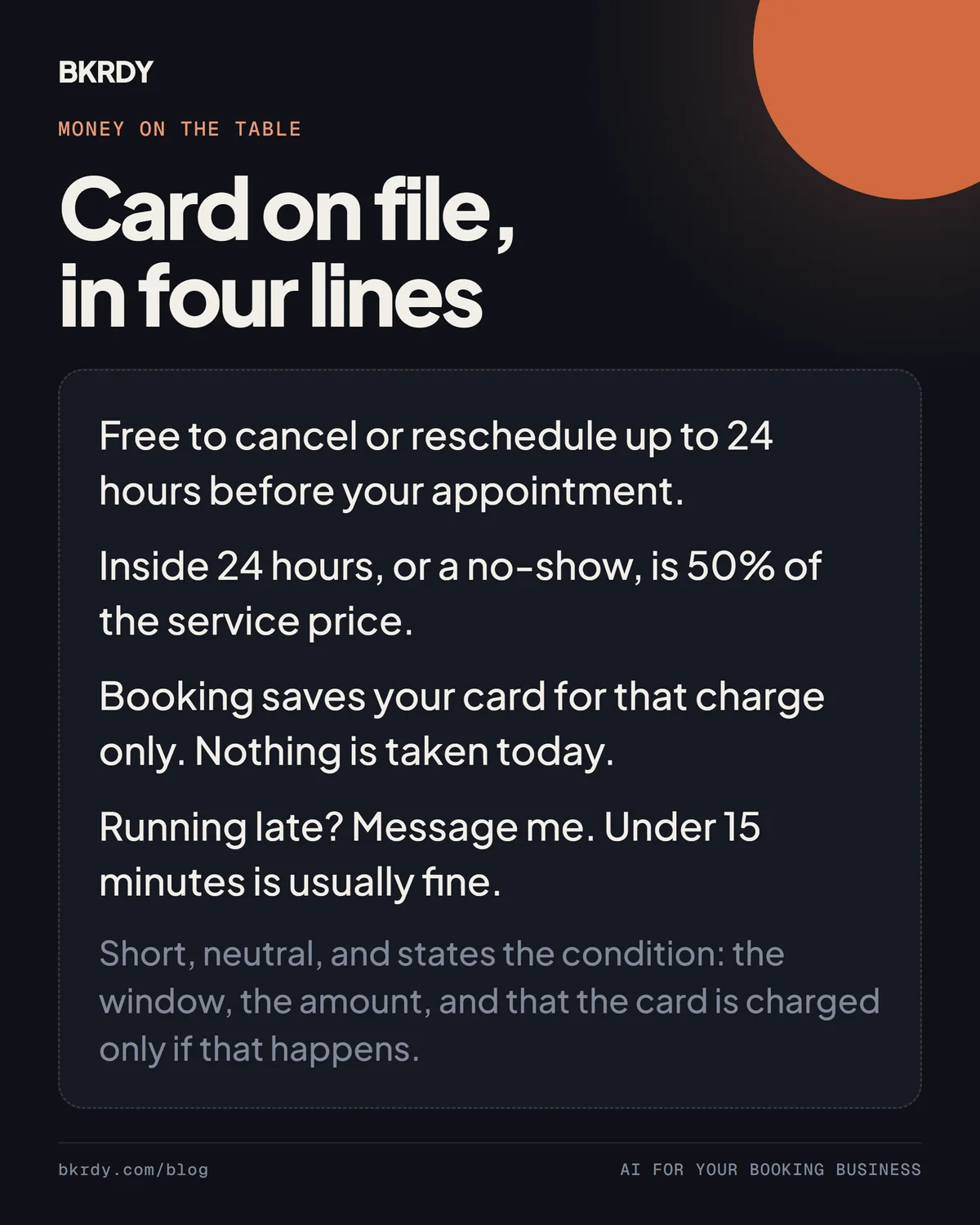
The wording that works is short, neutral and states the condition: the window, the amount, and that the card is charged only if that happens.
What breaks it is explaining. So no "unfortunately", no "I hate to have to do this", and never the version that blames the last person who ghosted you. The client reading it did turn up, every time, and you have just made them the suspect.
The longer the explanation, the more it sounds like something you are asking permission for.
Four lines cover it, including the question everyone has: being late rather than absent.
Card on file wording for your booking page
Put the same lines in the confirmation message, word for word. If your wording needs more work than this, start from a cancellation policy template.
The first time you charge one, send it the same day
- Same day. A fee that arrives Friday for a Tuesday miss reads as a grudge you sat on. The same afternoon reads as process.
- Reference the window, not the person. "Your 2pm fell inside the 24 hour window" is a fact about a time. "You didn't show up" is a fact about them, and they will answer it like an accusation.
- Offer the next opening in the same message. The fee covers an hour you lost. The rebooking is what you want.
The message to send on the day you charge a fee
Most people reply with an apology and take a slot. A few go quiet for good, and those were usually already drifting.
Waive it sometimes, and still send the policy
There are charges you should not make.
- A first miss from a long-standing client. One no-show in two years is not a pattern, it is a Tuesday.
- A genuine emergency. You will know one when you read it. Do not interrogate anyone, and do not ask about a medical situation.
- Anything that costs more in goodwill than the fee is worth. The client halfway through a six-appointment plan, or the one who sent you four people last year.
Waiving it without losing the rule means doing both halves. Refund the charge quietly, say in one line that you have taken the fee off this once, and still include the same cancellation wording you send everybody. No lecture. They keep their money, you keep the policy, and the rule was never withdrawn, only not applied.
The failure mode is waiving it and dropping the subject. Do that twice and your clients sort themselves into the ones who argue and the ones who pay.
Some clients will not book if a card is required
A few people will reach the card field and close the tab. A few will say so in your messages, and one or two will be rude about it. You will lose bookings, and most of them are the ones that would have gone missing anyway, which you can only see in hindsight.
Be honest about where your book is, though. If you are new and your Tuesdays are empty, requiring a card on every service costs more than it saves. Start where a miss hurts: Saturdays, prime evenings, anything over 90 minutes. Widen it once you can see which slots get ghosted. If the real problem is that people forget, reducing no-shows starts with reminders.
And for the client who genuinely will not save a card, one line keeps them: message me and we will book it in directly.
Questions
Do I need the client's permission to charge the card later?
Yes, and the agreement at booking is that permission. They are shown the window, the amount and the fact that their card is saved for that charge, and they agree before they get the slot.
Should I use a deposit or a card on file?
A deposit for long or supply-heavy services, where the appointment costs you money before they arrive. A card on file for shorter repeat services, where taking money up front from a regular feels wrong.
Can I waive the fee without losing the policy?
Yes, if you do both halves. Refund the charge quietly, say in one line that you have taken it off this once, and still send your normal cancellation wording. Waiving it and dropping the subject is what turns a policy into a suggestion.