Blog Running the week
The squeeze-in: saying yes without wrecking your day
Decide this now, while nobody is asking. The squeeze-in is the one appointment you always answer under pressure, with a brush in your other hand, and the answer usually turns on how nicely the person asked rather than what it costs you.
Which is why two clients can send the same request in the same week and get different answers, and neither will ever know why.

Saying no feels like saying no to them
The request almost never comes from someone unreasonable. It comes from a good client who shows up, tips and sends their friends. They have a real reason: a funeral on Saturday, a flight Friday, a job interview. And they ask the way people ask when they know they are pushing it. Any chance. I know you are probably full.
That phrasing is the whole problem, because no stops sounding like "that time is not available" and starts sounding like "you are not worth it to me". So you say yes, and that is not weakness. What is missing is a rule, not backbone, and without one the slot goes to whoever words the ask best.
The appointment is 30 minutes. The cost is not.
In the moment you price the service: half an hour, they are quick, fine. That is not what you are spending.
- The buffer. The 15 minutes between your 2pm and your 3pm is how you clean down, write the notes and start the next client calm.
- The lunch. The squeeze-in lands in the only gap in the day. That is the gap you eat in.
- Everyone after them. You start eight minutes late and it compounds. The 6pm client, who did nothing wrong, waits.
- The precedent. The expensive one, and it shows up later.
The client you squeeze in once has not learned that you did them a favour. They have learned that the calendar is negotiable.
Six weeks on they ask again, with less preamble, behaving exactly as you taught them.
Three conditions, and all three have to be true
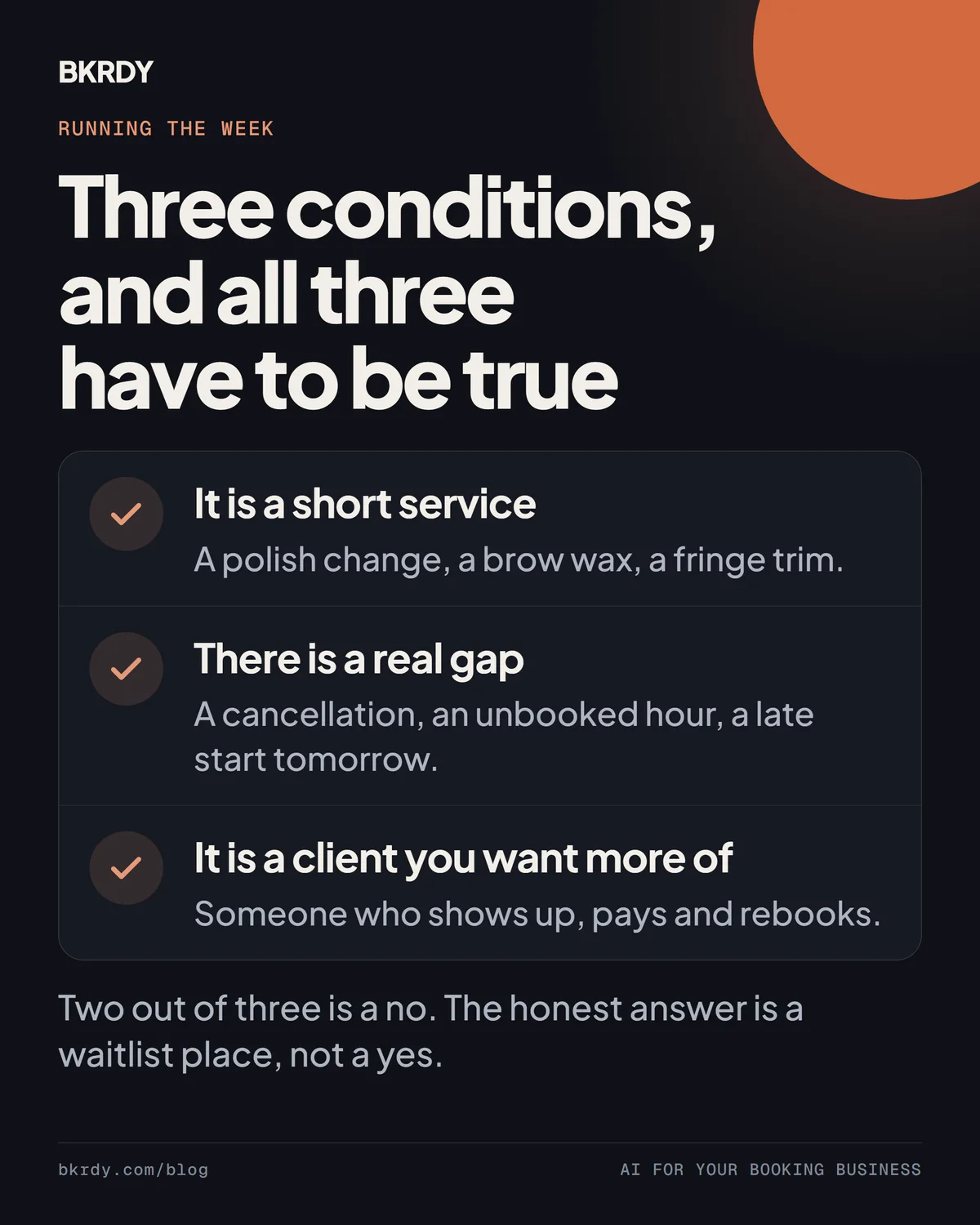
Yes only when all three are true. Two out of three is a no.
- It is a short service. A polish change, a brow wax, a fringe trim. Squeezing a full set into a gap is not a squeeze-in, it is a second job that starts at the end of your first one.
- There is a real gap. A cancellation, an unbooked hour, a late start tomorrow. A gap you make by trimming someone else or eating your break is a loan against your own day.
- It is a client you want more of. Someone who shows up, pays and rebooks. This is a judgement and you are allowed to make it. The regular who has never cancelled on you has earned something the serial rescheduler has not.
Three conditions beats a feeling, because you can apply them in nine seconds.
Charging for it is not greedy
An appointment outside your normal pattern costs more to deliver than one inside it. Pricing it differently is honest, not opportunistic. Anyone with a same-day rate does the same.
The fee does two things, and the second matters more. It pays for the disruption, which is fair. And it means the request only arrives when the client genuinely needs it: a free squeeze-in gets asked for whenever it would be mildly convenient, a $20 one when there is a funeral on Saturday.
Say the fee before you confirm, never after, because a charge explained at the chair reads as a surprise and costs more goodwill than it collects. Take it when you approve rather than on the day, same as any deposit: a short notice no-show costs you the break you gave up for it. The usual no-show protections apply more here, not less.
The better answer is usually neither yes nor no
Listen to what is actually being asked. Almost nobody wants 7pm Thursday specifically. They want to come sooner than the appointment they have, and only one of those requests costs you your day.
So answer the real one. Put them on the cancellation list, and when somebody drops out of Wednesday at 11, the slot is theirs. Same client, same week, and now they are delighted rather than squeezed, because a freed slot is a lucky break instead of a favour you quietly pay for. More on running one well in how waitlists keep clients.
On paid plans, BKRDY handles both halves: clients can send a squeeze-in request that you approve or decline, with its own fee folded into the appointment total, and a cancellation waitlist offers freed slots to the people waiting. Nothing is charged until you approve it.
Say the no in one sentence
The no is a sentence, not a conversation. Short, no apology tour, no account of how busy you have been, always with a specific alternative attached. "I am fully booked" is a dead end.
Two replies, ready to send
Neither one says sorry, and neither explains. You are not confessing to anything.
Zero is the wrong target
A shop that never bends reads as rigid, and rigid loses the odd client to the person down the road who said yes. That flexibility is part of why people pick a small business over a chain.
So the goal is not zero. It is that the ones you do are chosen rather than extracted, a difference your clients will never notice and your Thursdays will.
Questions
What counts as a squeeze-in?
Any appointment you take outside your normal pattern because someone asked at short notice. It is defined by the asking rather than the clock, so an evening slot that sits in your calendar at a set price is just an appointment.
Should I charge extra for fitting a client in last minute?
Yes, if you want to keep offering it. It costs you more to deliver than a normal appointment, so a fee is fair, and it has a second effect: the request stops arriving for minor convenience. State the fee before you confirm, never afterwards.
How do I turn down a last minute request without losing the client?
Give the no and an alternative in the same message. Say you are full that day, say they are top of your cancellation list, and name a time you can do. It lands softly because it arrives with something in its hand.
Is a waitlist better than squeezing people in?
For most of these requests, yes, because the client wants to come sooner, not that exact slot. A waitlist uses a gap that already exists, so your break and the clients after them stay untouched.